Pool service monthly cost vs DIY is more than a comparison of a recurring invoice against chlorine purchases. Homeowners also need to account for water tests, filtration maintenance, seasonal repairs, time spent cleaning, and the cost of handling mistakes. The tables below break those inputs out so you can compare like with like.
Table of Contents
- Pool Service Monthly Cost: What You Actually Pay
- DIY Pool Maintenance Cost Per Month Breakdown
- What Is Included in Weekly Pool Service
- Pool Maintenance Supplies Checklist and Expenses
- Pool Maintenance Time Per Week: DIY Labor Reality
- Hidden Costs and Mistakes That Drain Your Budget
- Making Your Choice: Service or DIY
- Frequently Asked Questions
Last Updated: October 10, 2026
Pool Service Monthly Cost: What You Actually Pay
When you’re deciding between hiring a professional pool service and maintaining your pool yourself, the first question is always the same: how much will this actually cost? The answer depends entirely on what’s included in the service and how much work you’re willing to do yourself.
Professional pool service monthly cost varies based on pool size, location, and service frequency. At Reynolds Pool Service, we handle the complete water chemistry management and equipment maintenance so you don’t have to worry about whether your pool is safe to swim in.
The real cost difference between service and DIY isn’t just about the monthly fee. It’s about what you’re actually getting: consistent water clarity, balanced chemistry, equipment that runs reliably, and your time back on weekends. Many pool owners underestimate how much time weekly maintenance actually takes or how costly mistakes can be when chemicals are mishandled.
DIY Pool Maintenance Cost Per Month Breakdown
Going the DIY route means buying your own chemicals, testing supplies, and cleaning equipment. The trick is separating one-time startup costs from recurring monthly expenses, because the two behave very differently.
Startup costs (one-time, first 30 days):
| Item | Typical Cost | Replacement Cycle |
|---|---|---|
| Liquid reagent test kit (FAS-DPD) | $25-$60 | 1-2 years |
| Test strips (backup) | $10-$20 | Monthly |
| Telescoping pole | $25-$50 | 3-5 years |
| Wall brush | $20-$40 | 1-2 years |
| Leaf skimmer net | $15-$30 | 1-2 years |
| Manual vacuum head + hose | $50-$120 | 2-4 years |
| Thermometer | $8-$15 | 2-3 years |
| Startup total | $150-$335 | , |
Recurring monthly costs (chlorine pool, 15,000-gallon in-ground, moderate debris):
| Category | Monthly Range |
|---|---|
| Chlorine (liquid, tablets, or granular) | $40-$90 |
| pH up / pH down | $10-$25 |
| Alkalinity increaser | $8-$20 |
| Calcium hardness adjuster | $5-$15 |
| Cyanuric acid (stabilizer) | $5-$12 |
| Filter cleaning supplies | $5-$15 |
| Replacement test reagents | $8-$15 |
| Monthly supplies total | $81-$192 |
Pool-specific adjustments:
- Above-ground pool (5,000-8,000 gallons): roughly 40-60% of the chemical cost above, so $35-$90 per month in supplies.
- Saltwater system: you skip most chlorine purchases but add salt cell replacement amortization ($300-$900 cell lasting 3-7 years, or roughly $5-$25 per month) plus periodic salt bags ($8-$15 each). Net monthly supplies land near $60-$150.
- Screened enclosure: debris load drops sharply, so you can often stretch brushing and skimming to every 10 days and cut filter cleanings in half. Expect the low end of the range.
- Exposed pool under trees or in dusty climates: budget the high end plus an extra $20-$40 per month for additional chlorine and filter media.
The labor line item most comparisons skip. Routine DIY tasks run 1-1.5 hours per week for a clean pool and 1.5-2 hours when debris is heavy. At the federal minimum wage of $7.25 per hour, that’s $30-$60 per month. At a $25-per-hour opportunity cost, a reasonable proxy for many homeowners, it’s $100-$215 per month. That single line often exceeds the entire chemical bill, and it’s the number that makes the DIY-versus-service math flip.
Key Takeaway: Add equipment replacement (pump, filter, heater) on top, and the gap between DIY and professional service narrows fast.
Equipment costs add up too. You’ll replace these tools periodically as they wear out. If your pool equipment needs repair, a pump motor, filter cartridge, or heater issue, you’re paying for the repair plus the cost of being without proper equipment while you wait for parts or a technician.
What Is Included in Weekly Pool Service
A weekly pool service visit typically includes several core tasks that keep your pool safe and swimmable. The technician tests your water chemistry, adjusts pH and alkalinity, adds necessary chemicals, brushes the pool walls and floor, empties the skimmer and pump baskets, and inspects equipment for problems.
This consistency matters more than most pool owners realize. When someone checks your pool the same day every week, small issues get caught before they become expensive problems. A slight chlorine drop gets corrected before algae blooms. A pump bearing that’s starting to wear gets noticed before it fails completely. Equipment maintenance prevents the emergency repair calls that cost significantly more than routine service.
Weekly service also means your pool is always ready to use. You wake up on Saturday morning and the water is clear, balanced, and safe. You don’t spend your weekend troubleshooting chemistry problems or trying to figure out why the water looks cloudy. The professional service handles the technical knowledge, knowing exactly how much chemical to add, understanding what different test results mean, and knowing when equipment needs professional attention.
Pool Maintenance Supplies Checklist and Expenses
If you’re doing DIY maintenance, you’ll need specific supplies to keep your pool safe. A water test kit is essential, either a basic kit with test strips or a more detailed kit with liquid reagents that give more accurate results. You’ll need chlorine in some form, whether liquid, powder, or tablets depending on your pool type.
pH increaser and decreaser are necessary for keeping water chemistry balanced. Alkalinity increaser helps stabilize pH levels. If you have an in-ground pool with a filter, you’ll need filter cleaning supplies and possibly filter cartridges or sand depending on your filter type. A pool brush for wall cleaning, a skimmer net for debris, and ideally a pool vacuum for floor cleaning round out the basics.
The actual cost of supplies depends on your pool size and local water conditions. Larger pools need more chemicals. Pools in areas with high rainfall or heavy debris load need more frequent cleaning supplies. Pools in hard water areas may need additional chemical treatments. What starts as a modest monthly supply budget can grow significantly if your pool has challenging conditions.
Pool Maintenance Time Per Week: DIY Labor Reality
Most pool owners significantly underestimate the time commitment of DIY maintenance. A proper weekly routine includes water testing (15-20 minutes), brushing pool walls and floor (20-30 minutes), skimming debris (10-15 minutes), and equipment inspection (10 minutes). That’s 55 minutes to 1.25 hours per week minimum.
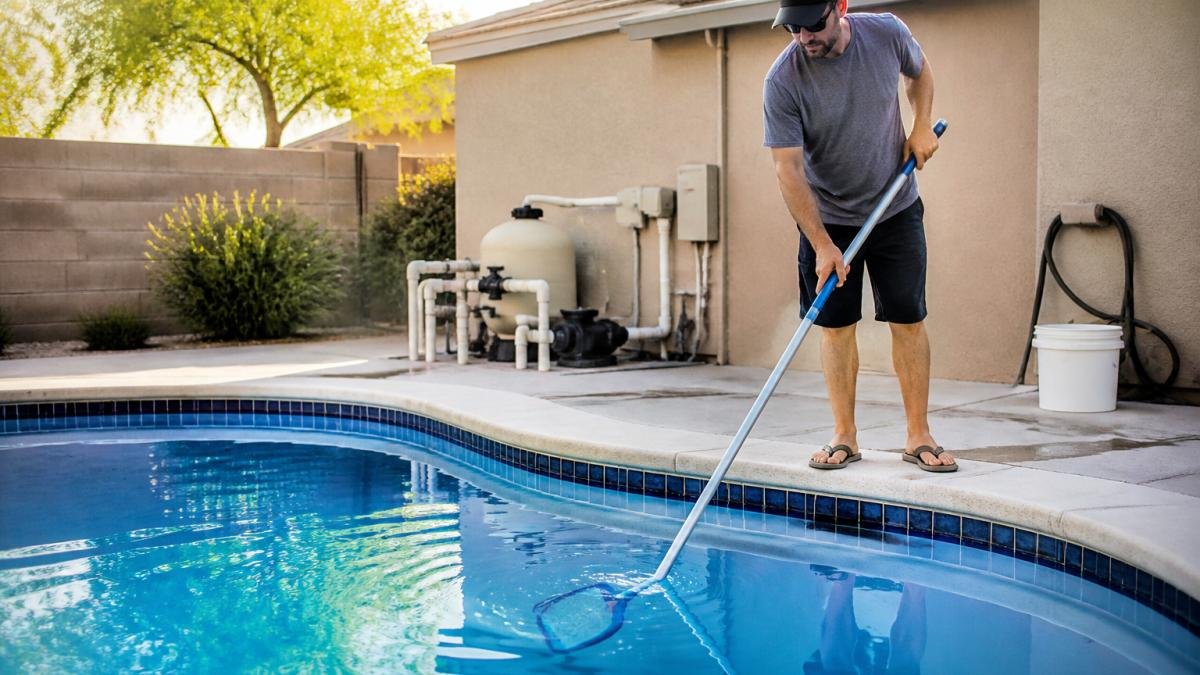
If your pool has heavy debris load from trees or weather, add another 30-45 minutes. If you need to clean filter equipment, add another 30-60 minutes every few weeks. If you’re learning as you go, add another 15-30 minutes per visit while you figure out what you’re doing. The reality is that consistent weekly maintenance often takes 1.5-2 hours per week for homeowners who are doing it properly.
Over a month, that’s 6-8 hours of your time. Over a year, that’s roughly 312-416 hours. If you value your time at even $20 per hour, you’re looking at $6,240-$8,320 annually in labor cost alone, before you even factor in supplies or mistakes.
Hidden Costs and Mistakes That Drain Your Budget
Most DIY-versus-service comparisons stop at the monthly invoice. The real swing factor is what happens when something goes wrong, and how much it costs to recover.
1. Chlorine lock from over-stabilization. If you chlorinate with trichlor tablets or dichlor shock, cyanuric acid (CYA) builds up over time.
2. Algae bloom from a missed week. A single skipped week in summer, especially after rain or a heat wave, can drop free chlorine to zero and let green algae establish.
3. pH crash and equipment damage. Low pH (below 7.0) is corrosive to pump seals, heater exchangers, and metal fittings. High pH (above 7.8) scales the salt cell and filter. Either extreme, sustained for weeks, shortens equipment life.
4. Chemical mixing injuries and surface damage. Adding chlorine and acid at the same time, or pouring chemicals into the skimmer, can create dangerous reactions and stain or etch plaster.
5. Water waste from repeated drain-and-refill cycles. Every chemistry mistake that requires dilution costs water. In areas with tiered water rates, a single 5,000-gallon refill can push you into a higher tier. Two or three of these per season erase any DIY savings.
6. The troubleshooting tax. Cloudy water that isn’t fixed on the first try typically means 2-4 trips to the pool store, chemicals that may not address the root cause, and a week or more of unusable water.
Watch Out: These aren’t worst-case scenarios, they’re the common ones. A single severe algae bloom or heater failure can wipe out a full year of DIY savings in one event.
How to price the risk. A reasonable way to compare DIY and professional service is to add a “mistake reserve” to your DIY budget. Most experienced pool owners who track their spending set aside for recovery costs, chemicals for a bloom, a partial drain, a replacement part. Add that to supplies and valued labor, and the DIY number often lands within of a basic weekly service plan. The service plan, in exchange, transfers the risk of those events to the provider.
The time cost of troubleshooting is real too. You spend an hour researching why your pool is cloudy. You buy chemicals you think will fix it. They don’t work. You research more. You buy different chemicals. Meanwhile, your pool is unusable for swimming.
Making Your Choice: Service or DIY
The decision between professional pool service monthly cost and DIY maintenance comes down to three factors: your available time, your tolerance for technical complexity, and your actual cost calculation.
If you have limited free time and prefer to spend weekends relaxing rather than maintaining equipment, professional service makes financial sense when you factor in your labor time. If you enjoy technical tasks and have consistent free time on the same day each week, DIY can work if you commit to the discipline of regular maintenance.
The cost comparison changes based on your specific situation. A small above-ground pool in a low-debris area with stable water conditions costs less to maintain DIY than a large in-ground pool in a high-desert climate with dust and debris load. A saltwater pool system requires different maintenance knowledge than chlorine systems. A pool with aging equipment needs more frequent inspection and repair than a newer pool.
Reynolds Pool Service specializes in serving pool owners across the High Desert region who understand that consistent, professional maintenance prevents expensive problems. We handle the technical complexity of water chemistry, the physical labor of weekly cleaning, and the equipment expertise that keeps systems running reliably. Our team provides the consistent service frequency that prevents the mistakes and emergencies that drain budgets.
| Maintenance Approach | Monthly Cost Range | Time Commitment | Equipment Knowledge Required |
|---|---|---|---|
| Professional Service | Request a quote | Zero hours | None required |
| DIY Maintenance | Supplies only, plus labor value | 6-8 hours weekly | Moderate to high |
| DIY with occasional service | Hybrid costs | 3-4 hours weekly | Moderate |
The real pool service monthly cost question isn’t just about the invoice amount. It’s about whether the service prevents the larger costs of mistakes, equipment damage, water waste, and your own time. For many homeowners, that answer is clear.
Frequently Asked Questions
How much does DIY pool maintenance cost monthly?
DIY pool maintenance involves costs for chemicals, test kits, and cleaning supplies, depending on pool size and water chemistry needs. In-ground pools typically require more chemicals than above-ground pools. Costs rise if equipment repairs are needed or if mistakes like algae blooms occur, which can require expensive shock treatments and water recovery.
What is included in a weekly pool service?
Weekly professional pool service usually includes skimming debris, brushing walls, vacuuming the floor, cleaning the filter, testing water chemistry, adjusting chlorine and pH levels, and checking equipment function. Some providers also offer tile cleaning, pump inspection, and seasonal equipment maintenance. Service scope varies, request details on what’s covered before signing a contract.
How much time does DIY pool maintenance take each week?
DIY pool owners typically spend 4-8 hours per week on maintenance tasks: skimming debris, brushing, vacuuming, testing water, adjusting chemicals, and equipment checks. Time increases during heavy use, after storms, or if algae develops. For busy professionals and retirees wanting to avoid physical labor, this time commitment often outweighs the savings versus hiring a service.
Is professional pool service worth the monthly cost?
Professional service is worth it if you value your time, want consistent water chemistry, or lack the technical knowledge to balance chemicals safely. Service prevents costly mistakes like algae blooms or equipment damage. For pool owners in areas with heavy dust and debris, professional weekly service keeps water clearer and reduces your personal effort significantly compared to DIY maintenance.
Keeping your pool safe and clear requires consistent attention to water chemistry and equipment maintenance. Whether you choose professional service or manage it yourself, the key is understanding your actual costs and committing to regular maintenance. At Reynolds Pool Service, we handle the technical complexity and physical labor so your pool is always ready to enjoy. Request a free quote to see how professional service fits your budget and lifestyle.
Authoritative Reference
For additional guidance, see CDC guidance: pool water testing, chlorine and pH. The source supports general principles; specific service procedures should still follow the equipment manufacturer and local requirements.
Explore our High Desert pool services for on-site help.