
Pool equipment repair in Victorville often begins at the equipment pad: pumps, motors, filters, heaters, valves, and automation controllers work as one circulation system. A loss of flow, unusual noise, or recurring error code can point to different causes, so diagnosis should identify the failing component before parts are replaced.
Table of Contents
- Pool Equipment Repair Service in Victorville: How to Get It Right
- Pool Equipment Troubleshooting: Safe First Steps Before You Call
- Pool Pump Repair: Diagnosing the Most Common Failure
- Pool Equipment Repair Cost: What Drives the Price
- Pool Automation Repair: When Smart Controls Stop Responding
- Repair or Replace? A Decision Framework for High Desert Pools
- How to Choose and Verify a Pool Equipment Repair Service
- Preventive Maintenance That Stops Repeat Breakdowns
- Frequently Asked Questions
Last Updated: October 14, 2026
Pool Equipment Repair Service in Victorville: How to Get It Right
When a pump quits in the middle of a High Desert summer, you do not have weeks to shop around. You need a pool equipment repair service that answers the phone, shows up, and fixes the problem without inventing new ones.
Here is the part most guides skip: in Victorville, wind-blown dust and hard water do more damage to pool equipment than heavy use ever will. Fine grit gets past worn seals and grinds down pump bearings. Calcium-rich fill water scales heater exchangers from the inside out.
Below, we break down safe troubleshooting, repair-versus-replace decisions, and how to verify a technician before you hand over a service call fee.
U.S. Consumer Product Safety Commission guidance on pool and spa safety
Pool Equipment Troubleshooting: Safe First Steps Before You Call
Start with the obvious before you touch anything: check the breaker, confirm the pump is actually receiving power, and look at the water level at the skimmer. A surprising share of “dead pump” calls turn out to be a tripped breaker or a skimmer running dry, and both are things you can rule out in two minutes without opening a single panel.
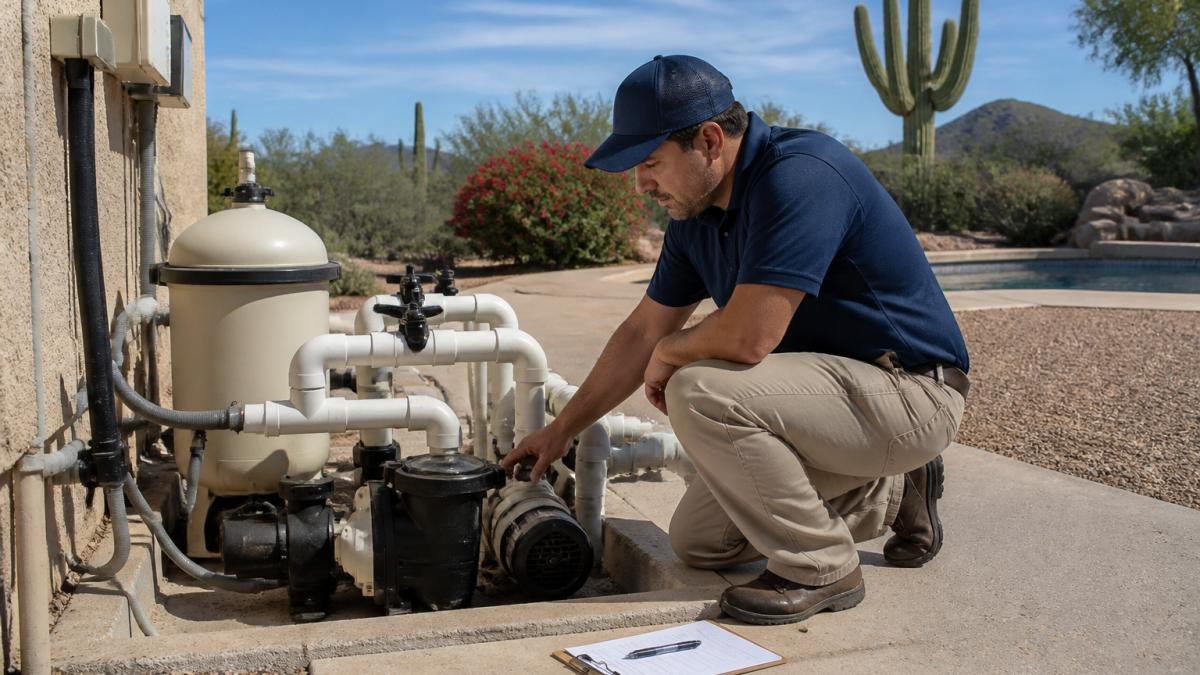
What to Check Before You Touch Anything
- Breaker at the panel: is it tripped or off?
- Water level: is it at least halfway up the skimmer opening?
- Skimmer and pump baskets: packed with debris?
- Visible leaks: puddles under the pump, filter, or heater?
- Timer or controller: is the pump actually scheduled to run?
If all five check out and the pump still will not start, stop there. That is a diagnostic problem, not a maintenance problem.
When to Shut Everything Down
Kill power at the breaker immediately if you see water spraying from the pump housing, smell burning near the motor, hear grinding or screeching, or notice the heater making popping sounds. Running a pump with a failed seal or a heater with scale-clogged plumbing turns a repair into a replacement. A pool technician can diagnose a dead pump; nobody can un-crack a housing that ran dry for an afternoon.
Watch Out: Never open a pump strainer lid or filter housing while the system is running, and never reset a breaker more than once on a pump that tripped it. Repeated tripping usually means a seized motor or a ground fault, and each reset attempt pushes the motor closer to total failure.
Pool Pump Repair: Diagnosing the Most Common Failure
Pool pump repair usually comes down to one of four failures: a worn seal leaking water, a failed capacitor preventing startup, a motor that has seized or is drawing high amps, or a cracked housing from freeze damage or dry running.
The seal is the one homeowners miss. A slow drip under the pump looks harmless, but it lets air into the system and water onto the motor bearings. In High Desert conditions, grit accelerates that wear, so a seal that might last years elsewhere can fail faster here.
When a motor is seized, screeching, or tripping the breaker, motor repair is rarely worth it. A qualified technician should tell you honestly when a replacement pump is the better spend.
Pool Equipment Repair Cost: What Drives the Price
Pool equipment repair cost is driven by four things: the part itself, how deep the technician has to go to reach it, whether it is an emergency call, and how old the equipment is. A capacitor swap on an accessible pump is a short, low-parts job.
Most shops in the High Desert price a service call as a flat diagnostic fee plus parts and labor. Ask which model your technician uses before you approve anything.
Here is how the major jobs typically break down by what actually drives the number:
| Repair | Typical cost drivers | What pushes it higher |
|---|---|---|
| Pump seal replacement | Seal kit, labor to pull and reseat the pump | Corroded housing, seized impeller, hard-to-reach pad |
| Pump capacitor or start switch | Small part, short labor | Motor already damaged from repeated reset attempts |
| Pump motor replacement | Motor, labor, possible plumbing rework | Voltage mismatch, undersized wiring, old union fittings |
| Filter cartridge or grid replacement | Cartridge or grid set | Oversized filter, hard water scale, cracked manifold |
| Heater exchanger or element | Exchanger or element, labor, gaskets | Scale damage, corroded headers, obsolete parts |
| Automation controller or actuator | Board, relay, actuator, transformer | Undersized transformer, heat-damaged enclosure, wiring faults |
| Electrical fault diagnosis | Diagnostic time, possible breaker or GFCI replacement | Ground faults, buried conduit, code corrections |
Two rules keep the bill predictable. First, ask for a written repair estimate before work starts, itemizing parts and labor separately. Second, ask whether the diagnostic fee is credited toward the repair if you approve it. Reputable shops say yes.
Pro Tip: Before you approve any repair, ask the technician to show you the failed part. A cracked seal, a bulged capacitor, or a corroded heater element is visible evidence. If the “failed part” never appears, you are paying for a guess.
Emergency and after-hours calls almost always carry a premium, and parts that have to be ordered add a second visit. If the equipment is old enough that the part is discontinued, the “repair” quote may quietly become a replacement quote, get that in writing too.
Pool Automation Repair: When Smart Controls Stop Responding
Pool automation repair starts with the power supply and the network, not the app. Nine times out of ten, a controller that “stopped working” has lost its transformer, its breaker, or its Wi-Fi connection, and the panel itself is fine.
If the panel powers on but ignores schedules, the issue is usually a firmware glitch or a failed relay. If the app works but nothing happens at the pad, you likely have a communication or actuator problem.
We install and service automation systems across the High Desert, and the honest truth is that most “automation failures” are installation problems: undersized transformers, exposed wiring, or controllers mounted where summer heat cooks them. Correct installation matters more than the brand on the box.
Repair or Replace? A Decision Framework for High Desert Pools
Use this framework before you approve any major repair. It applies to pumps, heaters, filters, and controllers alike.
| Situation | Recommendation | Why |
|---|---|---|
| Part under warranty, equipment under 5 years old | Repair | Replacement wastes a covered part |
| Motor seized or housing cracked | Replace | Repair cost approaches new unit |
| Heater exchanger scaled or leaking | Replace | Internal corrosion cannot be reversed |
| Controller failing repeatedly after repair | Replace | Repeat failures signal board-level damage |
| Single failed part, equipment otherwise sound | Repair | Cheapest path to a working pool |
The deciding question is simple: if the repair costs more than roughly half of a comparable new unit, and the equipment is already past its expected service life, replacement wins. In desert conditions, heat and dust shorten that service life, so factor that in.
Run the decision through five filters in order:
- Age versus expected service life. Most pool pumps are built for roughly 8 to 12 years of service, heaters for about 10 to 15, and filters for 15 or more with good care. High Desert heat, dust, and hard water tend to push equipment toward the low end of those ranges. If your unit is already near or past its expected life, weigh replacement heavily.
- Repair frequency. One failure is normal. Two or three failures in a single season is a pattern, and patterns usually mean the equipment is failing systemically, not just at one part.
- Efficiency. Older single-speed pumps and standard heaters cost more to run than modern variable-speed and high-efficiency models. Sometimes the energy savings alone justify replacement even when a repair is possible.
- Warranty. If the failed part is still covered, repair is almost always the right call. If the unit is out of warranty and the repair is major, the math shifts toward replacement.
- Parts availability. Discontinued parts turn a simple repair into a scavenger hunt. If the part is no longer made, replacement is usually the only honest answer.
Key Takeaway: Repair is the right call when the unit is young, the failure is isolated, and the part is available. Replacement wins when the unit is old, failures are repeating, or the repair cost approaches half the price of a new unit. Ask your technician to walk through all five filters before you sign off.
One more factor specific to this area: if your equipment pad sits in full afternoon sun with no shade, the enclosure and wiring take more heat than the manufacturer designed for. That shortens service life and is worth mentioning when you get a replacement quote, a small shade structure or a relocated pad can pay for itself over the life of the next unit.
How to Choose and Verify a Pool Equipment Repair Service
Verify three things before you book: licensing and insurance, a written estimate, and a real local address. A pool technician working on your equipment should be able to show proof of coverage, and any legitimate shop will put the estimate in writing. Ask for references from other homeowners in the area and actually call one.
Questions to Ask Before You Book
- Do you charge a diagnostic fee, and is it credited toward the repair?
- Will you provide a written estimate before starting work?
- What is your response time for a non-emergency service call?
- Do you carry parts for my equipment, or will you need to order them?
- Is your work guaranteed, and for how long?
Key Takeaway: The cheapest estimate is not the cheapest repair. A lowball quote that omits the diagnostic fee, the parts markup, or the follow-up visit costs more in the end. Compare total job cost, not the headline number.
Preventive Maintenance That Stops Repeat Breakdowns
Most repeat breakdowns trace back to skipped maintenance, not bad luck. A weekly service plan that includes basket cleaning, water chemistry checks, and a quick visual inspection of the equipment pad catches small problems before they become service calls.
For High Desert pools specifically, we recommend a preventive maintenance schedule built around dust season.
If you would rather not track any of this yourself, that is exactly what a full-service plan is for.
Equipment failures in the High Desert rarely announce themselves, and by the time a pump stops or a heater quits, you are already behind.
Frequently Asked Questions
What does pool equipment repair usually include?
Most repair visits cover diagnostics, parts replacement, and testing. A technician will check the pump, motor, filter, heater, and any automation controls. Common work includes replacing seals, impellers, capacitors, pressure gauges, and filter cartridges or grids. Some repairs, like pump motor swaps or heater igniter replacement, can be done on-site. Others, like cracked filter tanks or failed control boards, may require ordering parts. A good pool equipment repair service will explain what failed, why it failed, and what you can do to prevent a repeat.
How much does pool equipment repair cost?
Pricing depends on the equipment type, the failed part, and whether the technician needs to order components. A simple diagnostic visit costs less than a pump motor replacement or heater repair. Some providers charge a flat service call fee; others apply it toward the repair. Ask for a written repair estimate before work begins, and confirm whether parts and labor are billed separately.
How do I know if my pool pump needs repair or replacement?
If the motor hums but the impeller does not turn, the capacitor or windings may have failed, which is often repairable. Loud grinding, leaking seals, or repeated tripping usually point to worn bearings or a failing motor. A pump that runs hot, loses prime constantly, or costs more to run each month may be past its useful life. As a rule, if the repair cost approaches half the price of a new pump, replacement makes more sense. A pool technician can test amp draw and flow to give you a clear answer.
Can a pool technician repair pool automation systems?
Yes. Pool automation repair covers control panels, actuators, sensors, and wireless remotes. Common issues include unresponsive screen displays, valves that do not switch between pool and spa mode, and schedules that stop running. Technicians test low-voltage wiring, replace failed circuit boards, and reprogram settings. If your system is older and parts are no longer made, the technician may recommend upgrading to a current model. Ask whether the replacement parts carry a warranty.
Explore our High Desert pool services for on-site help.