Table of Contents
- Why Pool Equipment Care Decides What You Spend
- Pool Equipment Maintenance Checklist for Every Season
- Pool Pump Maintenance: Circulation, Impeller, and PSI Checks
- Pool Filter Cleaning by Filter Type
- Pool Equipment Troubleshooting: Symptoms and Safe First Checks
- Water Chemistry, Energy Settings, and Equipment Longevity
- When to Call a Technician and How to Plan for Replacement
- Frequently Asked Questions
Last Updated: October 21, 2026
Why Pool Equipment Care Decides What You Spend
Pool equipment care is the practice of inspecting, cleaning, and adjusting pumps, filters, and circulation components on a set schedule so they run efficiently and fail less often.
That’s the throughline of this guide. Equipment doesn’t die of old age so much as neglect.
Below, we’ll walk through a season-by-season maintenance checklist, pump and filter specifics, safe troubleshooting steps, and the point where you should stop diagnosing and call someone.
Most expensive pool repairs trace back to a small, cheap task that got skipped for a few weeks. The checklist matters more than the tools.
Pool Equipment Maintenance Checklist for Every Season
A pool equipment maintenance checklist is a recurring set of inspection and cleaning tasks tied to daily, weekly, monthly, and seasonal intervals, with each task assigned to a specific piece of equipment. The goal is simple: catch wear before it becomes a failure. What most generic checklists miss is that a pump, a cartridge filter, a gas heater, and a robotic cleaner do not share the same cadence, treating them as one list is how small tasks get skipped.
Daily and Weekly Tasks by Equipment
Daily tasks take minutes and protect the most expensive components. Weekly tasks restore circulation and give you the readings you will compare against all season.
| Interval | Equipment | Task | Trigger or Target |
|---|---|---|---|
| Daily | Skimmer and pump baskets | Empty debris | Before the basket is more than half full |
| Daily | Water line | Note the level | Keep water at the middle of the skimmer mouth |
| Weekly | Filter gauge | Log clean-starting PSI | Clean when pressure rises 8-10 PSI above baseline |
| Weekly | Pump | Listen and look | No grinding, no air bubbles in the strainer lid, no visible leaks |
| Weekly | Heater | Visual check | No error codes, no soot, no water under the unit |
| Weekly | Robotic or pressure cleaner | Empty bag or canister | Rinse the filter element; check the swivel and tracks |
Monthly and Quarterly Tasks
Monthly work is where most premature failures are prevented. Quarterly work is where you catch the slow leaks and worn seals that turn into repairs.
- Pump: Inspect the strainer lid O-ring for cracks and lubricate it with a silicone-based pool lubricant; a dry O-ring is a common cause of lost prime. Check the motor for unusual heat and clear any debris from the ventilation openings.
- Filter: Clean per type (see the filter section below). Inspect the pressure gauge, a gauge stuck at zero is a failed gauge, not a clean filter.
- Heater: Clear leaves and debris from around the unit, confirm the fan or vent is unobstructed, and check for scale on the heat exchanger if your water has been hard.
- Valves and fittings: Look for drips at unions, valve stems, and the backwash line. A slow drip is cheap now and expensive after a freeze or a season of corrosion.
- Cleaner: Inspect hoses for cracks, check the swivel on a suction cleaner, and replace worn brushes or tracks on a robotic unit.
Seasonal Prep and Off-Season Storage
Off-season storage deserves more attention than it usually gets. Drain water from exposed lines and equipment, secure covers so debris and standing water stay out, and store removable parts somewhere dry.
Before peak season, do a full pass: clean the filter, confirm the pump holds prime, test the heater, and re-baseline your pressure gauge. Write the clean-starting PSI on a tag at the equipment pad so anyone, including a house sitter, can tell when the filter needs attention.
A checklist is only useful if it is specific. Assign each task to one piece of equipment, give it a trigger (a PSI rise, a half-full basket, a visible drip), and log the result. That log is what turns maintenance into a replacement plan.
Pool Pump Maintenance: Circulation, Impeller, and PSI Checks
Pool pump maintenance comes down to three habits: keep the basket clear, listen for changes, and watch the pressure gauge. The pump is the heart of water circulation, and most pump problems announce themselves before they fail.
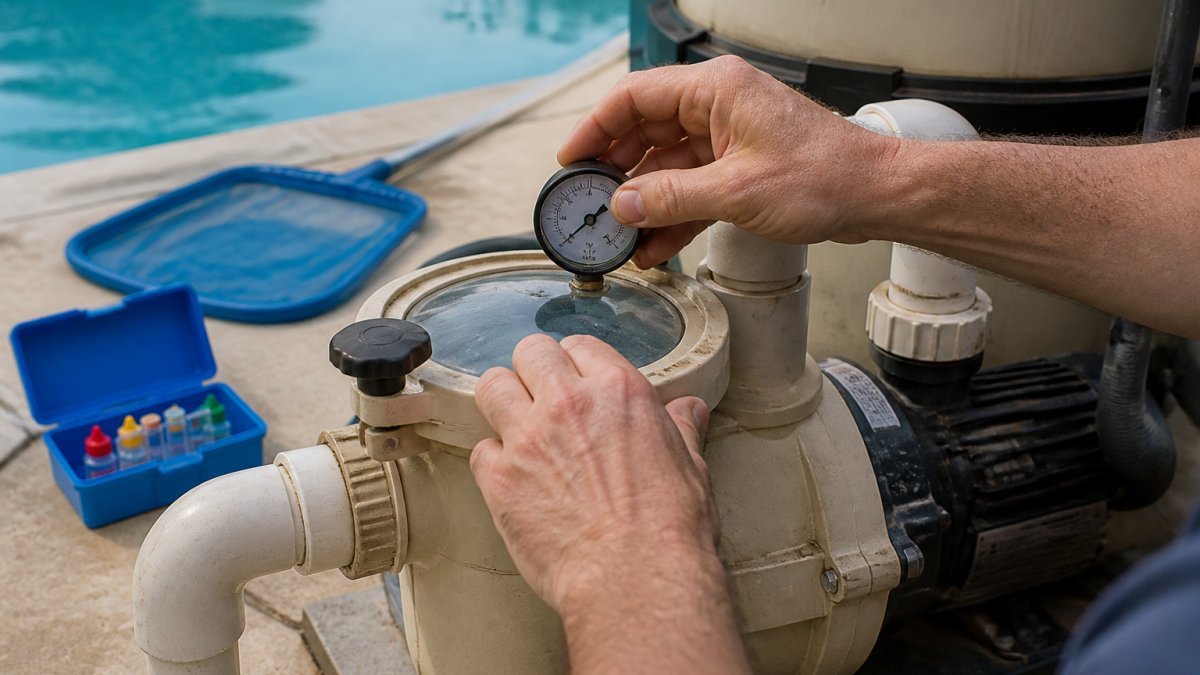
Start with the pump basket. A full basket restricts flow, which makes the motor work harder and can lead to overheating.
Running a pump with a clogged basket or a jammed impeller can overheat the motor and turn a cheap cleaning job into an equipment replacement. Shut it down first.
Pool Filter Cleaning by Filter Type
Pool filter cleaning means removing the debris and buildup that restrict flow, and the method depends entirely on which filter system you run. Cleaning on the wrong schedule or with the wrong method shortens filter life.
Sand, Cartridge, and DE Filter Differences
A sand filter traps debris in a bed of sand and gets cleaned by backwashing when pressure rises. A cartridge filter uses a pleated filter cartridge that you pull out and rinse or soak. A DE filter uses diatomaceous earth and is the most efficient of the three, but it needs the most careful handling. In every case, the trigger is the same: clean the filter when pressure climbs roughly 8 to 10 PSI above the clean starting point.
Pool Equipment Troubleshooting: Symptoms and Safe First Checks
Pool equipment troubleshooting starts with matching the symptom to the system, then doing only the safe first checks before calling a professional. The value is in knowing why a symptom appears, not just that it does, because the same symptom can point to a cheap fix or an expensive one.
Symptom-to-Check Guide
- Weak or no flow. Flow restrictions stack in order: a full pump basket, then a clogged impeller, then a dirty filter, then a closed or partially closed valve. Check them in that order. A pump that runs with restricted flow works harder and runs hotter, which is how a basket-cleaning task becomes a motor replacement.
- Pump won’t prime. Prime depends on a sealed suction side. Look first at the water level, if it is below the skimmer mouth, the pump is pulling air. Then check the strainer lid O-ring and the union on the suction line for air leaks. A blocked suction line or a stuck skimmer weir can also break prime.
- High filter pressure. Pressure climbs when the filter media loads up. Clean the filter and confirm the gauge is working; a gauge that does not move when you tap it is suspect. If pressure stays high after cleaning, the problem is downstream, a blocked return line or a valve issue.
- Low pressure with good flow. This often points to a gauge problem or a pump running below its rated speed. On a variable-speed pump, confirm the schedule has not been changed.
- Noisy pump. Grinding or screeching usually means a bearing or motor issue; rattling can be debris in the impeller; cavitation sounds like gravel moving and points to restricted suction. Shut the pump off before investigating.
- Heater error codes or short cycling. Check water flow first, most heaters will not fire without adequate flow. Then confirm the filter is clean and the pump is running at the speed the heater requires. Gas smell, soot, or repeated lockouts are stop-and-call situations.
- Cloudy water despite clean equipment. This is usually chemistry, not hardware. Confirm sanitizer level and pH before assuming a filter problem.
Where Safe Owner Checks End
Stop at the safe checks. Anything involving opening the pump housing, electrical components, gas lines, or a sealed heater belongs with a technician. The same is true for anything under warranty, many manufacturers require professional service to keep coverage, so a DIY repair can cost you the warranty along with the part.
Never open a pump housing, heater cabinet, or electrical panel while the equipment is powered. Shut off power at the breaker first, and if you are not certain which breaker controls the equipment, call a technician.
When to Call a Technician
Call when a problem involves electrical work, gas heaters, sealed pump components, or anything you have already checked once without a fix. Also call if you see water where it should not be, smell gas, or hear a noise that changes with pump speed. A technician with a pressure test and a multimeter can find in minutes what a visual check cannot.
Water Chemistry, Energy Settings, and Equipment Longevity
Water chemistry is equipment care, whether or not it feels like it. Unbalanced water scales up heat exchangers, corrodes metal parts, and stresses seals. The U.S. Department of Energy guidance on pool pump energy use is a useful reference for how pump runtime affects operating costs. For chemistry specifics, the CDC guidance on healthy swimming and water treatment covers the basics of balanced, sanitized water.
When to Call a Technician and How to Plan for Replacement
Call a technician when a problem involves electrical work, gas heaters, sealed pump components, or anything you’ve already checked once without a fix.
At George Reynolds Pool Service, we handle routine maintenance, equipment repair, professional tile cleaning, and pool automation for homes and commercial properties across the High Desert. Our Certified Startup Technician and Certified Pool Operator keep equipment running so you’re not the one diagnosing a pump at midnight.
Frequently Asked Questions
How often should pool equipment be inspected?
A quick visual check belongs in your weekly routine: look at the pump basket, skim the surface, and glance at the filter pressure gauge. A deeper inspection of the pump, filter, heater, and valves makes sense monthly, and a full seasonal inspection before peak season catches wear and tear early. If you run a commercial pool or host heavy bather loads, shorten that cycle. Your pool equipment maintenance checklist should list the task, the interval, and the reading you recorded so you can spot trends instead of reacting to failures.
What are the most common pool equipment problems?
Low water flow from a clogged pump basket or impeller, filter pressure that climbs 8 to 10 PSI above the clean baseline, air leaks on the suction side, and worn O-rings and gaskets top the list. Most of these trace back to skipped pool filter cleaning or debris left in the skimmer. Pool equipment troubleshooting starts with the simplest check: confirm water level, empty the baskets, and read the gauge before assuming a part has failed. Catching these early is far cheaper than equipment replacement.
What chemicals help keep a pool clean without damaging equipment?
Balanced water protects equipment more than any single chemical. Keep pH in the 7.4 to 7.6 range, maintain proper alkalinity and calcium hardness, and use chlorine or a sanitizer suited to your system. Low pH erodes pump seals, heater cores, and metal fittings; high calcium scales the filter and heater. Avoid mixing chemicals or adding them directly to the skimmer, which sends concentrated doses through the pump and filter. Test the water weekly and adjust in small steps so pool chemicals never sit out of range for long.
When should pool equipment be repaired or replaced?
Repair first when the fix is a seal, gasket, impeller, or capacitor and the motor still runs within normal amperage. Replace when the motor housing is cracked, the pump has been repaired twice in a season, or the unit is well past its typical service life and energy bills are climbing. For filters, replace cartridges when cleaning no longer restores pressure and the pleats are matted. Ask for a written estimate before work begins, and factor replacement planning into your budget so a failure does not become an emergency bill.
How can you extend the life of a pool pump?
Keep the pump basket clear, confirm the impeller is free of debris, and never run the pump dry. Check the water level so the skimmer does not pull air, and fix suction leaks promptly because air causes the pump to overheat. Give the motor proper ventilation and clear debris from around the housing. Follow a consistent pool pump maintenance routine, including inspecting seals and listening for unusual noise. Running the pump on the shortest schedule that still turns over the water also reduces wear and energy use.
Pool equipment care is mostly a discipline of small, repeated tasks, and the pools that stay cheap to own are the ones where somebody actually does them. If you’d rather hand that list to a team that shows up on schedule, George Reynolds Pool Service offers consistent maintenance, expert equipment repair, and automation that takes the guesswork out of runtime. Request a free quote and we’ll build a maintenance plan around your pool and your equipment.