This commercial pool service guide explains how property managers can coordinate water-quality testing, filtration, equipment maintenance, documentation, and qualified contractors for shared-use pools. Hotels, apartments, HOAs, and other public-use facilities must also follow the rules of their governing California and local health authorities.
Table of Contents
- What Commercial Pool Service Actually Covers
- The Commercial Pool Maintenance Checklist Property Managers Need
- Commercial Pool Water Testing and Chemistry Standards
- Commercial Pool Leak Detection: Signs You Can’t Ignore
- What Drives Commercial Pool Service Cost
- How to Vet a Commercial Pool Service Provider
- Conclusion: Managing the Vendor, Not Just the Water
- Frequently Asked Questions
Last Updated: October 14, 2026
What Commercial Pool Service Actually Covers
Pool service for commercial properties is the contracted maintenance of shared swimming pools at apartments, condominiums, HOAs, hotels, and community centers, covering water chemistry, sanitation, filtration, and equipment checks. It differs from residential service in one important way: facility owners and operators must coordinate health-code compliance and recordkeeping under applicable state and local requirements.
Reynolds Pool Service works with commercial properties across the California High Desert, where windblown dust, hard water, and triple-digit summer heat push chemistry out of balance fast. That environment shapes everything below.
A commercial route visit usually includes:
- Water testing and chemical adjustment
- Surface skimming and debris removal
- Brush and vacuum work on walls and floors
- Filter inspection, plus backwashing when pressure climbs
- Pump, heater, and controller checks
- Written logs for the health department
What most guides miss is that the water is the easy part. The paper trail is what closes pools.
The Commercial Pool Maintenance Checklist Property Managers Need
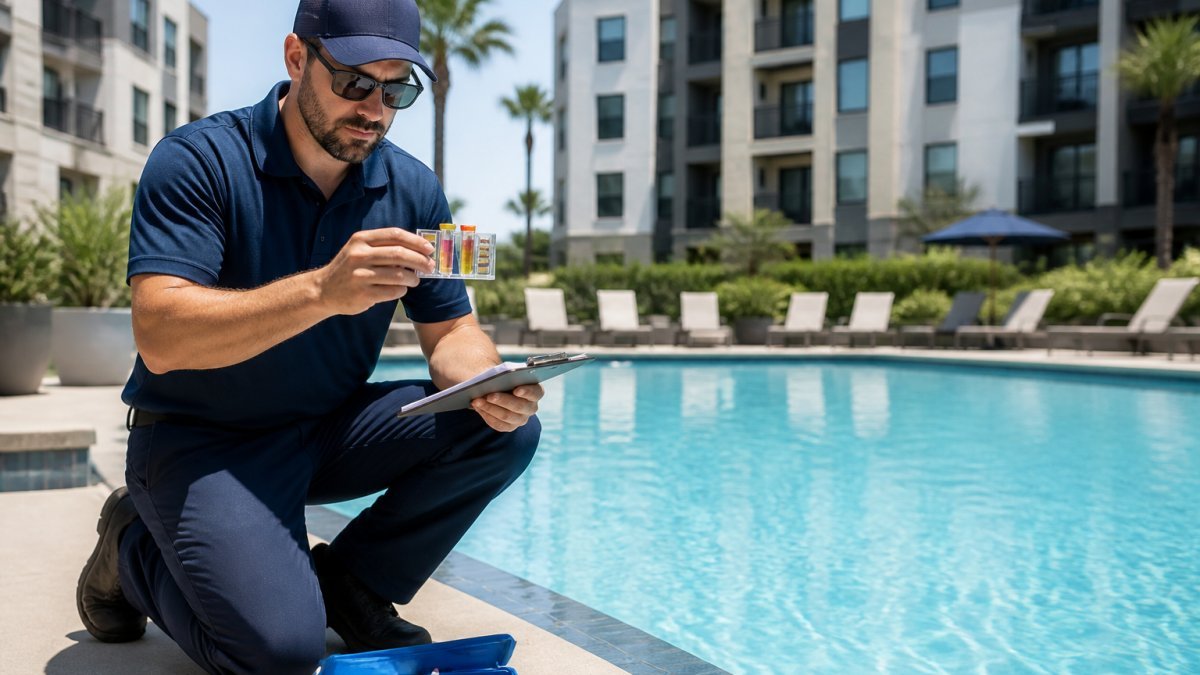
A commercial pool maintenance checklist is a written record of every task performed, when it was done, and what the readings were. It protects your property during an inspection and gives you something concrete to hold a vendor to.
Daily, Weekly, and Monthly Tasks
Most commercial pools need daily attention during swim season. A common approach is to divide work by frequency:
| Frequency | Tasks | Why It Matters |
|---|---|---|
| Daily | Skim debris, test chlorine and pH, check pump pressure | Catches chemistry drift before it turns water cloudy |
| Weekly | Full chemical balance, brush walls, empty skimmer baskets, inspect equipment | Prevents scale and keeps circulation efficient |
| Monthly | Backwash filters, clean tile at the waterline, review logs, check safety equipment | Stays ahead of inspections and calcium buildup |
Pro Tip: Photograph your pool deck and equipment pad after every visit. When a guest complains about cloudy water three days later, dated photos settle the question of whether the service actually happened.
Commercial Pool Water Testing and Chemistry Standards
Commercial pool water testing is the routine measurement of sanitizer, pH, alkalinity, calcium hardness, and stabilizer levels, documented at each visit. Your local health department sets the enforceable ranges, and those ranges govern your pool, not general pool advice.
In practice, free chlorine, pH, and total alkalinity get tested every visit. Calcium hardness and cyanuric acid need less frequent checks unless you’re topping off with hard fill water, which is common in desert markets.
Logs, Records, and Inspection Readiness
Health inspectors ask for three things: current readings, a record of corrections, and proof of operator training. Many states require a certified pool operator on staff for public pools, and the CDC guidance on pool operator training and water testing outlines why that certification matters for bather safety.
A log that shows a reading outside range with no corrective entry is worse than no log at all. It documents a problem you ignored.
Watch Out: Storing logs only in a technician’s truck is the most common compliance failure we see. Keep a duplicate on site, in a binder or digital folder, so the pool never sits closed waiting on paperwork.
Commercial Pool Leak Detection: Signs You Can’t Ignore
Commercial pool leak detection starts with three symptoms: water loss beyond normal evaporation, unexplained chemical demand, and wet ground near the equipment pad. Any one of these is worth investigating before it becomes a structural repair.
Evaporation in a hot, dry climate can hide a real leak for weeks. A useful test is the bucket method: fill a bucket with pool water, mark the level, set it on the top step, and compare its loss to the pool’s over 24 hours. If the pool drops faster than the bucket, you have a leak.
Symptoms to Log and Escalate
Not every symptom means the same thing. Some point to a plumbing leak, some to a shell leak, and some to equipment failure that mimics a leak.
- Cracks or settling on the deck, especially new cracks radiating from a skimmer or return fitting
- Air bubbles in the return lines, which often indicate a suction-side leak
- A pump that loses prime repeatedly, which can pull air through a failing fitting
- Rising water bills with no change in use or occupancy
- Persistent chemistry imbalance that resists correction, often a sign of dilution from make-up water
- Soft or sinking spots in the deck or surrounding turf
- Waterline tile that has dropped or separated from the shell
When to Close the Pool
This is the decision property managers get wrong most often. A small, stable leak that is not affecting chemistry, deck safety, or bather comfort can usually be monitored while a repair is scheduled. A leak that is dropping the water level faster than normal make-up can keep up, or that has caused visible deck movement or a soft spot, is a closure-level event. When in doubt, close and document. A closed pool is an inconvenience; an open pool with a structural failure is a liability.
Watch Out: If you suspect a leak near the suction lines or the main drain, keep bathers out until a technician has inspected. Suction-side leaks can compromise the entrapment protection system, and that is not a risk worth taking to stay open for a weekend.
How Commercial Leak Detection Actually Works
A technician will typically start with a visual inspection of the shell, fittings, skimmer throats, and light niches, then move to pressure testing of the plumbing lines. Dye testing at suspected cracks and fittings confirms whether water is moving through a breach. For underground plumbing, a pressure test isolates the leaking line so the repair can be targeted rather than exploratory. The goal is to locate the leak precisely before anyone breaks concrete.
Documenting the Leak for Your Records
Keep a written log of water loss measurements, dates, and any corrective action. If the leak leads to a closure, an insurance claim, or a health department visit, that log is your evidence that you identified and responded to the problem promptly. Photograph the water level against a fixed reference point, such as a tile line or skimmer throat, on each check.
Catching a leak early usually means a fitting or seal repair. Waiting can mean shell damage and a far larger bill.
What Drives Commercial Pool Service Cost
Commercial pool service cost depends on pool size, bather load, service frequency, water chemistry conditions, and how much equipment repair is bundled into the contract. Two pools the same size can carry very different monthly rates, and the reason is almost always frequency and chemistry, not the square footage of water.
Most property managers want a number before they call. Here is how to build one yourself so you can sanity-check any quote you receive.
The Five Cost Drivers, Ranked by Impact
1. Visit frequency. This is the single largest line item.
2. Bather load. More swimmers means more sunscreen, sweat, urine, and organic matter entering the water, which consumes sanitizer faster and drives up chemical demand.
3. Water chemistry conditions. Hard fill water, high evaporation, windblown dust, and heavy rain all push chemistry out of range and require more chemicals and more frequent testing.
**4.
5. Reporting and compliance overhead. If your jurisdiction requires a certified operator on site, daily log entries, or specific record retention, that labor has to be priced in.
How to Build a Budget Range Before You Call
You will not get an exact number without a site visit, but you can bracket it. Multiply your expected visits per month by the vendor’s per-visit labor rate, then add an estimated chemical allowance and a repair reserve. Most property managers find that chemical costs run a meaningful fraction of labor, and that repair reserves should be set aside monthly rather than absorbed as surprise expenses.
A practical approach:
- Get your pool’s gallonage from the equipment pad or original plans.
- Count the months your pool is open and how many visits per week it needs.
- Ask three vendors for a per-visit rate, a chemical allowance, and an hourly repair rate.
- Compare the totals, not the monthly headline.
How to Compare Quotes Without Getting Burned
Ask every vendor for the same items, in writing:
- Number of visits per month, with days specified
- What’s included versus billed as an extra
- Chemical costs: included or passed through, and at what markup
- Emergency response time and after-hours rates
- Reporting format and who receives it
- Contract term, cancellation notice, and price escalation clause
- Proof of insurance and any required state or local licensing
A low bid with vague inclusions usually costs more by month three. The U.S. Small Business Administration guidance on comparing vendor contracts makes the same point about written scope: what isn’t specified isn’t owed.
Watch Out: Watch for contracts that exclude chemical costs entirely. A pass-through chemical clause with no cap can double your monthly bill in a bad algae season. Ask for a chemical allowance with a defined overage rate.
We don’t publish flat rates because a quote built without seeing your equipment pad is a guess. Request a free quote and we’ll price the actual pool.
How to Vet a Commercial Pool Service Provider
Vetting a commercial pool service provider comes down to credentials, references, and reporting. Ask for proof of certification, then call two properties of similar size and type.
Our team holds Certified Pool Operator and Certified Startup Technician credentials, and we serve both residential and commercial accounts.
What most reviews skip is the reporting question. Ask to see a sample service report before signing. If a vendor can’t produce one, they aren’t documenting your pool, and you’ll be the one explaining that to an inspector.
The Occupational Safety and Health Administration guidance on pool chemical handling is also worth reading before you store chemicals on site. Improper storage is a citation risk and a real hazard for staff.
Conclusion: Managing the Vendor, Not Just the Water
The hard part of pool service for commercial properties isn’t finding someone to skim leaves. It’s managing a vendor who documents their work, responds when equipment fails, and keeps your pool open through an inspection.
Reynolds Pool Service handles that side of it. Our team brings Certified Pool Operator credentials, commercial-scale route capacity, and clear written reporting to every property we serve, along with specialized tile cleaning for calcium buildup and pool automation that reduces manual oversight. Request a free quote and we’ll walk your pool and equipment pad before we price a thing.
Frequently Asked Questions
What does commercial pool service include?
A commercial pool service typically covers routine cleaning, debris removal, water chemistry testing and balancing, equipment inspection, filter maintenance and backwashing, and system diagnostics. Many providers also handle repairs, leak detection, and emergency response. For properties like HOAs, condominiums, apartments, and hotels, the service plan should also include record-keeping for regulatory compliance and inspection readiness. Ask any provider for a written scope before signing, since what’s included varies significantly between companies.
How much does commercial pool maintenance cost?
Commercial pool service cost depends on pool size, number of pools on the property, service frequency, water chemistry complexity, and whether repairs are included. Pricing also varies by region and season. Because these factors differ so much from property to property, most providers quote custom pricing after an on-site evaluation. Request a free quote and ask for a line-item breakdown so you can compare proposals fairly rather than comparing a single monthly number.
How often should a commercial pool be cleaned and serviced?
Most commercial pools need service at least once or twice per week, and high-traffic properties like hotels and community centers may need daily attention during peak season. Water testing frequency depends on bather load and local health department rules. Your maintenance schedule should be property-specific, not a generic template. Ask your provider to document how often they’ll test water, clean filters, inspect equipment, and log results so you have a clear service standard to hold them to.
How can you tell if a commercial pool has a leak?
Common signs include water loss of more than a quarter inch per day beyond normal evaporation, unexplained spikes in chemical use, wet spots or sinking ground near the pool deck, and air bubbles in the pump basket or return lines. Because evaporation rates vary with heat and wind, a bucket test is a simple first check. If water loss persists, professional leak detection using pressure testing and dye testing can pinpoint the source before it damages equipment or the pool structure.
Authoritative Reference
For additional guidance, see California public-pool operation record requirements (Title 22 text). The source supports general principles; specific service procedures should still follow the equipment manufacturer and local requirements.
Explore our High Desert pool services for on-site help.