Preventing algae in High Desert pools requires more than an occasional chlorine treatment. Strong sun, airborne dust, high bather loads, and changes in circulation can all increase demand on the sanitizer and filtration system. A consistent testing and cleaning routine helps address those causes before the water turns green.
Table of Contents
- Why High Desert Conditions Accelerate Algae Growth
- Maintaining Adequate Pool Chlorine Levels
- Optimize Your Pool Pump Run Time to Prevent Algae
- Establish a Pool Brushing Schedule That Works
- Pool Filter Cleaning and Backwashing Essentials
- Testing Water Chemistry and Shocking Your Pool
- Managing Dust, Heat, and Weather Events
- Conclusion
- Frequently Asked Questions
Last Updated: October 11, 2026
Why High Desert Conditions Accelerate Algae Growth
High desert environments create perfect conditions for algae to thrive. The intense sun, low humidity, and temperature swings of regions like Apple Valley and Victorville accelerate algae growth. Preventing algae in high desert pools requires understanding these unique challenges.
Strong UV exposure and rapid evaporation break down chlorine faster than in other climates. Dust storms and monsoon rains introduce debris and nutrients. High desert conditions accelerate algae growth when homeowners rely on standard maintenance routines.
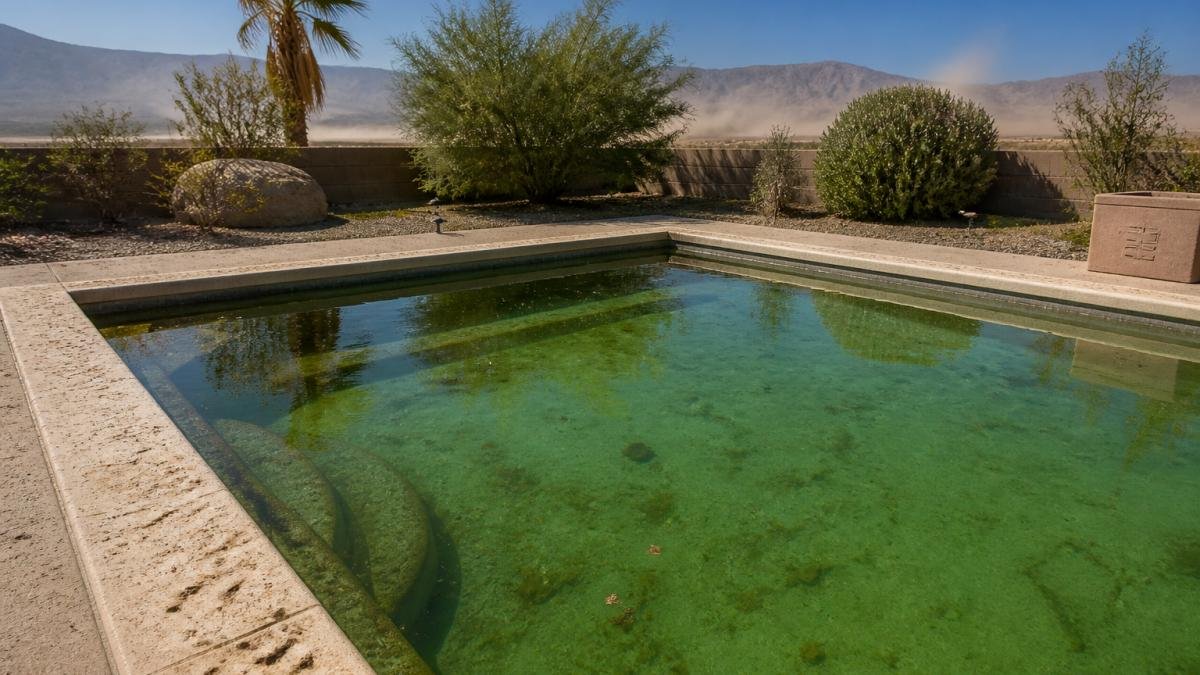
Algae feeds on sunlight, warm water, and nutrients like phosphates and nitrogen, all abundant in high desert pools. Rapid evaporation concentrates minerals and makes chemistry harder to balance. When chlorine drops even slightly, algae blooms within days.
Standard maintenance schedules don’t account for the speed of algae growth. You need a more aggressive approach to prevent algae in high desert pools.
Pro Tip: High desert pools need chlorine testing and adjustment 2-3 times per week, not once. The intense sun and low humidity accelerate chemical breakdown far faster than typical maintenance schedules assume.
Maintaining Adequate Pool Chlorine Levels
Free chlorine is your primary defense against algae. Most pools need 1-3 ppm, but in the high desert, maintaining 2-3 ppm can help buffer against rapid UV breakdown.
Test chlorine twice weekly during summer, early morning and late afternoon. If either test shows chlorine below 2 ppm, add more immediately.
How to raise chlorine:
- Liquid chlorine works fastest (raises levels within hours)
- Chlorine tablets dissolve slowly and maintain steady levels
- Shock treatments provide a heavy dose when levels drop dangerously low
- Combine tablets for steady maintenance with liquid chlorine for quick fixes
High desert sun breaks down chlorine rapidly, expect to lose 0.5-1 ppm daily on 100 degrees F days. Monitor closely and adjust weekly rather than waiting for monthly testing.
Watch Out: Chlorine below 1 ppm cannot kill algae spores effectively. Green water can develop within 24-48 hours once chlorine drops this low. Check levels every 2-3 days during peak heat to catch problems early.
Optimize Your Pool Pump Run Time to Prevent Algae
Your pump circulates water through the filter, removing debris and distributing chlorine evenly. Poor circulation is a top reason preventing algae in high desert pools fails.
Running your pump 10-12 hours daily during summer can help keep water moving and distribute chlorine evenly.
Pump run-time schedule:
- April-May: 8 hours daily
- June-August: 10-12 hours daily (peak season)
- September-October: 8-10 hours daily
- November-March: 4-6 hours daily (winter maintenance)
Check pump output regularly. If water flow looks sluggish or you hear unusual noises, have the pump inspected, many pool problems trace back to circulation issues.
Run your pump during the day when the sun is strongest. Some owners run twice daily in extreme heat: morning and evening cycles.
Establish a Pool Brushing Schedule That Works
Brush all walls, floor, and ledges at least twice weekly, three times per week during peak summer heat. Brushing can help prevent algae from spreading into the water.
Use a stiff brush for plaster pools and softer brush for vinyl liners. Brush in long, overlapping strokes and pay special attention to shaded areas and corners where circulation is weakest.
Brushing best practices:
- Brush before running the filter (loosens debris for capture)
- Spend extra time on north-facing walls (shadiest areas)
- Brush the waterline where algae often starts
- Work systematically from one end to the other
High desert dust settles quickly. Brush more frequently during dust storm season to remove organic matter that feeds algae.
Key Takeaway: The most common mistake is brushing randomly instead of systematically. Work the same pattern every time so you don’t miss areas where algae hides.
Pool Filter Cleaning and Backwashing Essentials
Backwash your filter weekly during summer, or whenever pressure reads 8-10 psi above starting pressure. A clean filter can help maintain circulation and remove debris that feeds algae.
Backwashing steps:
- Turn off the pump
- Set the filter valve to “backwash”
- Turn the pump on for 3-5 minutes until water runs clear
- Turn off the pump
- Set the valve back to “filter”
- Restart the pump
Backwashing removes trapped debris and restores filter flow. High desert pools need backwashing more often because dust and debris load is higher.
Clean or replace your filter cartridge every 2-3 months during the active season. A well-maintained filter can be a second line of defense after chlorine.
Check filter pressure weekly. Rising pressure indicates a clogged filter; falling pressure might signal a leak. Address either quickly to maintain circulation.
Testing Water Chemistry and Shocking Your Pool
Test water chemistry weekly using a reliable test kit. Track four numbers: free chlorine, pH, total alkalinity, and cyanuric acid (stabilizer). High desert pools require more frequent testing due to higher UV intensity and evaporation.
Target ranges for high desert pools:
- Free chlorine: 2-3 ppm
- pH: 7.2-7.6
- Total alkalinity: 80-120 ppm
- Cyanuric acid (stabilizer): 30-50 ppm
Cyanuric acid helps protect chlorine from UV breakdown (Effect of Cyanuric Acid on the Inactivation of Cryptosporidium parvum under…). Without adequate stabilizer (30-50 ppm), chlorine can burn off quickly.
High-desert testing schedule:
- April-May (spring startup): Test twice weekly
- June-August (peak heat): Test 3 times per week (Monday, Wednesday, Friday minimum)
- September-October (monsoon season): Test twice weekly after rain events
- November-March (winter): Test weekly
pH affects chlorine effectiveness. If pH exceeds 7.8, chlorine can become less effective and water may cloud. If pH drops below 7.0, it can potentially damage equipment and irritate skin.
Total alkalinity buffers pH and prevents rapid swings. If alkalinity exceeds 150 ppm, water can become difficult to balance and chlorine efficiency may drop. Using pH decreaser can help lower both pH and alkalinity.
Troubleshooting algae despite adequate chlorine: If free chlorine reads 2-3 ppm but algae appears:
- Stabilizer too low: Add stabilizer and retest in 24 hours.
- Stabilizer too high (above 60 ppm): Drain 25-30% and refill to dilute stabilizer.
- pH too high: Lower pH first, then retest chlorine.
- Poor circulation: Run pump longer and brush more frequently.
- Filter clogged: Backwash or clean immediately.
- Testing inaccuracy: Use a drop-test kit or digital tester stored in a cool, dark place, not cheap strips.
When to shock your pool:
- Weekly during peak summer heat (June-August)
- After heavy rain or dust storms
- If water turns cloudy or green
- After heavy pool use (parties, events)
- After a heat wave (shock twice weekly if temperatures exceed 105 degrees F)
Pool shock can help kill algae spores, bacteria, and oxidize organic matter. Shocking at dusk can help prevent chlorine from burning off immediately. Waiting 8-12 hours before swimming is generally recommended. In high desert pools during peak summer, shocking twice weekly (Monday and Thursday) may help manage algae pressure.
Pro Tip: Buy a quality test kit, not cheap strips. Digital testers or drop-test kits give accurate readings. Inaccurate testing can lead to wrong chemical adjustments, which may allow algae to thrive. Store your test kit in a cool, dark place, heat and sunlight degrade reagents and give false results.
Watch Out: If you see green water or visible algae despite chlorine reading 2-3 ppm and pH in range, suspect stabilizer imbalance or filter failure first. Shock the pool and brush thoroughly, then retest stabilizer and check filter pressure. Do not assume your chlorine test is wrong, assume your stabilizer or circulation is the problem.
Managing Dust, Heat, and Weather Events
High desert weather creates sudden, predictable challenges that standard pool maintenance doesn’t address. Dust storms, monsoon rains, and extreme heat waves each require a specific response plan.
Dust storm response:
Dust storms are common April-June and late summer. A single event deposits pounds of organic matter into your pool.
Before a dust storm:
- Close or lower any pool cover
- Run pump and filter continuously during the storm
- Do not add chemicals during the storm
After a dust storm:
- Brush all surfaces thoroughly
- Run filter for 12+ hours
- Test chlorine the next morning, expect a 0.5-1.5 ppm drop
- Add chlorine to restore 2-3 ppm
- Test again 24 hours later
Dust contains nitrogen and phosphates that feed algae. Aggressive brushing and extended filtration can help remove organic matter before it triggers algae growth.
Monsoon rain response:
Monsoonal moisture arrives July-September. Heavy rain dilutes pool chemistry.
Before heavy rain:
- Lower water level by 2-3 inches if rain exceeds 1 inch
- Do not add chemicals the day before rain
After heavy rain:
- Test pH and total alkalinity first, these drop with dilution
- Test free chlorine
- If pH dropped below 7.0, add pH increaser
- If alkalinity dropped below 80 ppm, add alkalinity increaser
- Add chlorine to restore 2-3 ppm
- Brush to remove debris
- Run filter 8+ hours
- Retest the next morning
Rain is slightly acidic, so pH often drops. Address pH and alkalinity before adding chlorine, chlorine is less effective in low-pH water.
Heat wave response:
Extreme heat (105 degrees F+) accelerates chlorine breakdown and evaporation. A 110 degrees F day can consume 1-2 ppm of chlorine.
During a heat wave:
- Increase pump run time to 14-16 hours daily
- Test chlorine daily
- Brush 3+ times per week
- Shock twice weekly (Monday and Thursday)
- Cover the pool when not in use
- Top off water level every 2-3 days
- Monitor filter pressure daily
Covering your pool during extreme heat can help reduce water loss and chlorine breakdown. This may also reduce dust and debris settling overnight.
Evaporation and water level management:
Top off your pool regularly to maintain water level at the middle of the skimmer opening. Add water slowly in early morning or evening.
Seasonal weather patterns:
High desert regions experience predictable seasonal patterns. Plan your maintenance schedule around these patterns:
- April-May (spring dust season): Expect frequent dust storms. Increase brushing to 3+ times weekly. Keep the filter clean by backwashing weekly or more often.
- June-August (peak heat and UV): Chlorine demand is highest. Test 3 times per week. Shock twice weekly. Run the pump 12-14 hours daily.
- July-September (monsoon season): Prepare for sudden heavy rain. Monitor forecasts and adjust water level before storms. Test chemistry after each rain event.
- October-November (cooling period): Chlorine demand decreases. Reduce testing to twice weekly. Reduce pump run time to 8-10 hours daily.
- December-March (winter maintenance): Chlorine demand is lowest. Test weekly. Run the pump 4-6 hours daily. Maintain chlorine at 1-2 ppm to prevent algae during cooler months.
National Weather Service high desert forecasts can help you prepare for sudden weather changes. Monitor forecasts for dust storms, extreme heat, and monsoon rain so you can adjust maintenance proactively rather than reacting after chemistry crashes.
Conclusion
Preventing algae in high desert pools requires commitment to routine maintenance and chemistry management. The intense sun, low humidity, and temperature swings often demand more frequent testing, brushing, and chemical adjustment than standard guidelines recommend. Reynolds Pool Service provides consistent, reliable maintenance and expert repairs, ensuring your equipment runs efficiently so you can spend more time enjoying your pool. Request a free quote from Reynolds Pool Service and simplify your pool care.
Frequently Asked Questions
How do you prevent algae in a high-desert pool?
Preventing algae in high-desert pools requires consistent chlorine residuals (2-4 ppm free chlorine), daily circulation with your pump running 8-12 hours, regular brushing of pool walls and surfaces, and weekly filter backwashing. High-desert conditions, intense UV, low humidity, and dust, accelerate algae growth, so maintaining these baselines is critical. Test water chemistry twice weekly during summer months and shock your pool weekly to eliminate algae spores before they bloom.
How often should you test pool water during hot weather?
Test your pool water twice weekly during hot weather and summer months. High temperatures and strong sunlight deplete chlorine faster, so frequent testing ensures your free chlorine stays in the 2-4 ppm range. Test pH (7.2-7.6) and total alkalinity (80-120 ppm) at the same time. If you notice any cloudiness or early algae signs, test daily until the problem is resolved.
How long should a pool pump run to prevent algae?
Your pool pump should run 8-12 hours daily to maintain adequate circulation and prevent algae. In high-desert climates with intense heat, aim for the higher end (10-12 hours) during summer months. Proper water flow ensures chlorine distributes evenly, prevents dead zones where algae thrives, and keeps debris moving toward the filter. Consider pool automation to ensure consistent run times without manual adjustment.
What should you do if algae starts appearing in your pool despite adequate chlorine?
If algae appears despite adequate free chlorine levels, shock your pool with double the normal dose, then brush all pool walls and surfaces vigorously to break up algae cells. Run your pump continuously for 24 hours and backwash your filter frequently. If the problem persists, consult a professional. High-desert dust and monsoon rains can introduce nutrients that standard chlorine alone cannot handle.
Authoritative Reference
For additional guidance, see CDC guidance: pool water testing, chlorine and pH. The source supports general principles; specific service procedures should still follow the equipment manufacturer and local requirements.
Explore our High Desert pool services for on-site help.