DIY pool chemistry vs professional service comes down to testing consistency, chemical handling, equipment knowledge, and the time you can devote to the water. Knowing free chlorine, pH, total alkalinity, calcium hardness, and stabilizer matters regardless of who does the work.
Table of Contents
- DIY Pool Chemistry: What You’re Actually Taking On
- How Often to Test Pool Water and Why It Matters
- Understanding Pool Chemical Levels Chart and Safe Dosing
- Choosing the Right Pool Water Testing Kit
- Pool Maintenance Cost: DIY Expenses vs Professional Fees
- Professional Pool Service: What You Get and When It Pays Off
- Making Your Decision: Key Factors That Determine the Right Choice
- Frequently Asked Questions
Last Updated: October 10, 2026
DIY Pool Chemistry: What You’re Actually Taking On
DIY pool chemistry means managing water balance, chemical testing, and treatment on your own schedule.
Maintaining pool chemistry yourself requires consistent attention: regular testing, understanding results, adjusting chemical levels, and troubleshooting problems. Some owners thrive with this hands-on approach; others find the learning curve steeper than expected.
At Reynolds Pool Service, we’ve worked with countless homeowners who started with DIY maintenance. Some stick with it for years; others call within months, frustrated by algae blooms or cloudy water.
DIY pool chemistry isn’t just adding chlorine, it’s testing, adjusting, monitoring, and preventing problems before they start.
Pro Tip: Pool water chemistry is seasonal. Winter requires different maintenance than summer. If you’re in a region with cold months, your routine will shift dramatically, lower chlorine demand, different pH challenges, and equipment considerations that change with temperature.
How Often to Test Pool Water and Why It Matters
Testing frequency determines whether your pool stays clear or turns green. Test at least twice weekly during swimming season, once weekly during off-season.
Saltwater systems require more frequent testing, twice weekly minimum, because salt chlorinators need stable alkalinity and pH.
Chemical imbalances don’t announce themselves. A pool can look clear while pH creeps upward or alkalinity drops. Consistent testing catches drift before cloudiness or algae appears.
Heat waves, heavy rain, or high bather load shift water chemistry quickly. Testing before you think you need to is the only way to stay ahead.
Watch Out: Skipping tests for two weeks during summer is one of the most common mistakes. Your pool may look fine for days, then suddenly develop algae or cloudy water. Once that happens, fixing it takes much longer than maintaining balance would have.
Understanding Pool Chemical Levels Chart and Safe Dosing
Pool water chemistry involves four main measurements: chlorine, pH, alkalinity, and calcium hardness.
Chlorine (0.5-3.0 ppm) kills bacteria and algae. Too low and algae grows.
pH (7.2-7.6) measures acidity. Below 7.2, water becomes corrosive and damages equipment.
Alkalinity (80-120 ppm) acts as a pH buffer. It prevents wild pH swings when you add chemicals.
Calcium hardness (200-400 ppm) prevents water from dissolving pool surfaces. Too high and calcium deposits form on tile and equipment.
Safe dosing depends on pool volume.
Never mix chemicals in the water. Add one chemical, wait, test, then add the next.
Choosing the Right Pool Water Testing Kit
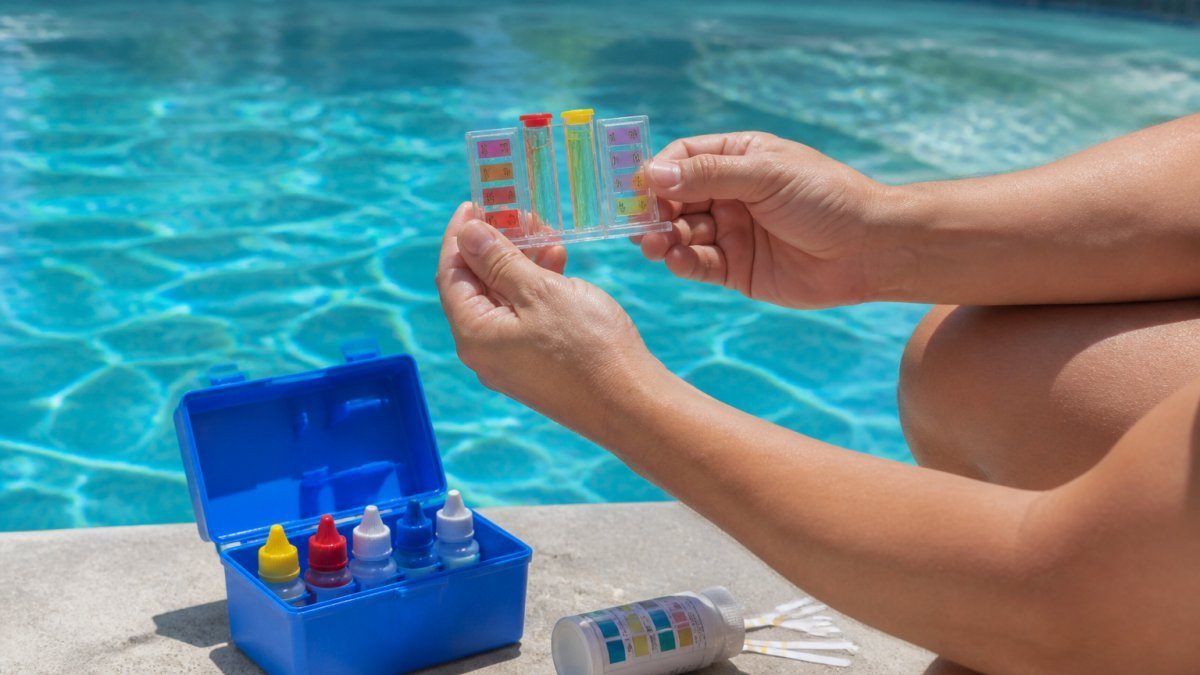
A quality pool water testing kit is essential for DIY maintenance. Your choice directly affects your ability to catch chemical imbalances before they become visible problems.
Test Strip Limitations and When They Fail
Test strips are fast and cheap ($20-$40 per bottle) but accuracy is moderate. Color-matching is subjective, and two people may interpret the same strip differently, especially for pH and alkalinity, which drift most frequently.
Strips degrade rapidly with humidity, heat, or light exposure. Stored in a bathroom or poolside shed, they may read 0.5 pH points off by mid-summer, leading to incorrect adjustments.
Strips work for basic chlorine monitoring but fail at precision balancing. For troubleshooting cloudy water, high pH, or alkalinity drift, they lack the precision needed.
Liquid Test Kits: Accuracy Trade-offs
Liquid test kits use chemical reagents and titration to measure chemicals. They’re slower (5-10 minutes per test) but significantly more accurate. Upfront cost is $40-$100, but cheaper per test over time.
Liquid kits measure chlorine, pH, alkalinity, and acid demand (how much acid is needed to lower pH to target). Some advanced kits add calcium hardness and cyanuric acid (stabilizer) testing.
The accuracy advantage matters. A liquid kit can detect a 0.2 pH shift that a strip would miss.
Liquid kits require discipline: fresh reagents, accurate water temperature, careful drop counting. Many DIY owners revert to strips because the process feels tedious.
Professional Testing Equipment: The Accuracy Gap
Professional pool services use digital meters and laboratory-grade reagent kits that measure to higher precision than consumer equipment. A digital pH meter reads to 0.01 pH units; a consumer strip reads to 0.5 units.
This matters because small imbalances compound. A pH that’s 0.3 points high doesn’t look wrong on a strip, but over two weeks it causes cloudiness. A professional catches it at the first visit and corrects it before it becomes visible.
Professional equipment also includes tools DIY kits don’t: calcium hardness testers, cyanuric acid readers, and saturation index calculators that predict whether water will cloud or corrode equipment.
Choosing a Kit That Matches Your Commitment Level
If you’re serious about DIY chemistry, invest in a liquid test kit from a reputable brand (look for kits that include a pH test, alkalinity test, and acid demand test as a minimum). Budget $50-$80 and plan to spend 10 minutes per test.
If you prefer speed and simplicity, accept that strips will miss subtle drift. Plan to test more frequently (three times per week instead of two) to compensate for lower accuracy.
If you’re uncertain whether you’ll stay consistent with testing, this is a sign that professional service may be the better choice. A kit sitting unused is worse than paying for professional testing.
Key Takeaway: Testing accuracy determines whether you catch chemical drift early or troubleshoot problems after they become visible. Liquid kits offer precision closer to professional standards; strips offer convenience at the cost of precision. Choose based on how much time you’ll realistically invest and how comfortable you are with measurement error.
Pool Maintenance Cost: DIY Expenses vs Professional Fees
DIY pool chemistry has real costs that many homeowners underestimate. A true cost comparison requires itemizing chemicals, supplies, equipment, and the hidden cost of mistakes, then comparing that total to professional service fees across a full year.
Itemized DIY Costs: What You Actually Spend
Chemicals are the largest recurring expense. A typical 15,000-gallon residential pool requires:
- Chlorine (liquid or tablets): $15-$40 per month during swimming season (May-September in most regions), $5-$10 per month during off-season. Annual chlorine cost: $100-$200.
- pH increaser (soda ash) and pH decreaser (muriatic acid): $10-$25 per month during heavy-use season. Annual cost: $60-$150.
- Alkalinity increaser (sodium bicarbonate): $5-$15 per month. Annual cost: $40-$100.
- Calcium hardness increaser: $0-$30 per year (needed only if your water is naturally soft).
- Algaecide and shock treatment (for correcting problems): $20-$60 per incident. Most DIY owners experience 1-3 algae blooms or cloudiness events per year that require extra treatment. Annual cost: $40-$180.
- Stabilizer (cyanuric acid) (added once per season): $10-$20 per year.
Total annual chemical cost: $250-$640 for a 15,000-gallon pool with routine maintenance and 1-2 corrective treatments.
Testing supplies:
- Liquid test kit (initial): $50-$100. Lasts 2-3 years with annual reagent replacement ($20-$40).
- Test strips (if you prefer): $25-$40 per bottle, lasting 6-8 weeks. Annual cost: $150-$250.
- Digital thermometer (optional but useful): $10-$20 (one-time).
Total annual testing cost: $40-$100 (liquid kit with reagent replacement) or $150-$250 (strips).
Equipment maintenance and repairs:
- Filter cleaning/replacement: Cartridge filters need cleaning every 2-4 weeks ($0 if you do it yourself, $50-$100 per professional cleaning). Sand filters need backwashing (free) but replacement every 5-7 years ($300-$600). Annual cost: $0-$100 if you maintain it yourself.
- Pump maintenance: Typically $0 annually if running smoothly, but unexpected repairs (seal replacement, motor issues) cost $200-$800.
- Skimmer and drain basket replacement: $20-$50 per year.
- Brush, net, and vacuum equipment: $30-$80 per year (replacement as items wear out).
Total annual equipment cost: $50-$250 for routine maintenance, plus $0-$800 for unexpected repairs.
Time cost (opportunity cost):
DIY requires 4-8 hours per month of testing, chemical adjustment, and troubleshooting. Over a year, that’s 48-96 hours. If you value your time at $25-$50 per hour (a conservative estimate for skilled labor), the opportunity cost is $1,200-$4,800 per year. Most homeowners don’t count this, but it’s real.
Total DIY Cost Across a Full Year
Assuming routine maintenance with 1-2 corrective treatments and no major equipment repairs:
- Chemicals: $250-$640
- Testing supplies: $40-$250
- Equipment maintenance: $50-$250
- Subtotal (out-of-pocket): $340-$1,140 per year
- Time cost (if valued): $1,200-$4,800 per year
- Total including time: $1,540-$5,940 per year
If you experience a major problem (algae bloom requiring acid wash, pump failure, filter replacement), add $300-$1,500.
Professional Service Costs: What’s Included
Professional pool service costs $100-$250 per month for weekly visits, including water testing, chemical balancing, debris removal, brush and tile cleaning, equipment inspection, and emergency service. Annual cost: $1,200-$3,000 for weekly service, or $600-$1,500 for biweekly.
Some services charge extra for acid washing ($200-$500), equipment repairs (20-30% discount vs. independent shops), or seasonal opening/closing ($150-$300 each).
The Real Cost Comparison
| Cost Category | DIY (Annual) | Professional (Annual) |
|---|---|---|
| Chemicals | $250-$640 | Included |
| Testing supplies | $40-$250 | Included |
| Equipment maintenance | $50-$250 | Included |
| Out-of-pocket subtotal | $340-$1,140 | $1,200-$3,000 |
| Time investment (valued at $25/hr) | $1,200-$4,800 | $0 |
| Corrective treatments (algae, cloudiness) | $40-$180 | Included |
| Total with time cost | $1,540-$5,940 | $1,200-$3,000 |
When DIY Saves Money (And When It Doesn’t)
DIY is cheaper out-of-pocket if you have flexible time, live in stable water conditions, have a small pool, stay consistent, and avoid algae blooms. DIY becomes expensive if you experience one major algae bloom, have a saltwater system, live in hard-water or algae-prone regions, miss testing for 2-3 weeks, or accidentally overdose chemicals.
Professional service is cheaper when you factor in time and becomes cost-neutral or cheaper out-of-pocket if you would otherwise spend $200+ correcting mistakes or miss testing frequently enough that problems develop.
Key Takeaway: DIY costs $340-$1,140 per year out-of-pocket, or $1,540-$5,940 including your time. Professional service costs $1,200-$3,000 annually. The break-even point is whether you value your time and whether you can maintain consistency without mistakes. One major algae bloom or two weeks of missed testing often makes professional service the cheaper option.
Professional Pool Service: What You Get and When It Pays Off
Professional pool services visit weekly or biweekly to test water, adjust chemicals, clean debris, brush walls, and monitor equipment. Technicians understand seasonal shifts, handle saltwater systems and automation, and use professional-grade testing equipment more accurate than consumer kits.
Professional service pays off fastest if you have a saltwater system, live in challenging water conditions (high minerals, extreme pH, algae-prone water), lack time for weekly testing, or have struggled with DIY algae or clarity issues.
According to the CDC guidance on pool water quality, proper chemical maintenance prevents illness and equipment damage. Professional services ensure consistent compliance with those standards.
Making Your Decision: Key Factors That Determine the Right Choice
The DIY versus professional choice depends on five factors: time, chemistry comfort, pool size, water conditions, and risk tolerance.
Ask yourself: Will you test consistently every week? Can you handle chemical safety responsibly? Do you enjoy problem-solving or does it stress you? Your answers determine which path makes sense.
The choice between DIY pool chemistry and professional service isn’t about which is “better”, it’s about which fits your life. DIY works for detail-oriented homeowners with flexible schedules and comfort around basic chemistry. Professional service works for everyone else.
Reynolds Pool Service specializes in professional pool maintenance and water chemistry management across the High Desert region. We handle testing, chemical balancing, equipment monitoring, and tile cleaning so you can enjoy your pool without the learning curve or time commitment.
Frequently Asked Questions
Is it cheaper to maintain pool chemistry yourself?
DIY pool chemistry typically costs less upfront, chemicals and a testing kit run $200-400 annually. However, the true cost includes your time, equipment, and mistakes that damage equipment or water quality. Professional service costs more monthly but eliminates guesswork, prevents costly damage, and includes equipment expertise. For busy homeowners or those with complex pools, professional service often costs less when you factor in your time and avoided problems.
How often should pool water chemistry be tested?
Test your pool water 2-3 times weekly during swimming season if you maintain it yourself. Professional services typically test weekly or more frequently. Testing frequency depends on pool usage, weather, and whether you have a saltwater or chlorine system. High-use pools or those in dusty environments need more frequent testing. Skipping tests risks algae growth, equipment damage, and unsafe water conditions.
Can incorrect pool chemical levels damage pool equipment?
Yes. Imbalanced pH and alkalinity corrode metal components, damage pumps, and degrade pool surfaces. High chlorine levels bleach liners and weaken equipment seals. Low chlorine invites algae, which clogs filters and strains pumps. Improper muriatic acid use can burn through equipment. These mistakes cost hundreds to thousands in repairs. Professional technicians understand chemical interactions and prevent damage through accurate testing and precise dosing.
When should I hire a professional to balance my pool water?
Consider professional service if your water repeatedly turns cloudy or green despite your efforts, you struggle with chemical dosing, your pool has equipment problems, or you lack time for weekly testing. New pool owners unfamiliar with chemistry, commercial property managers, and those with saltwater or automated systems benefit most from professional expertise. Professionals catch problems early, preventing expensive repairs and ensuring safe, clear water year-round.
Authoritative Reference
For additional guidance, see CDC guidance: pool water testing, chlorine and pH. The source supports general principles; specific service procedures should still follow the equipment manufacturer and local requirements.
Explore our High Desert pool services for on-site help.