Commercial pool maintenance for property managers combines consistent sanitation, documented equipment service, scheduling around residents and guests, and clear responsibility for incident response. The maintenance plan should address water-test records, access, repair approvals, contractor reporting, and whichever state or local rules apply to each facility.
Table of Contents
- What Commercial Pool Maintenance Includes
- Commercial Pool Service Frequency and Scheduling
- Water Testing, Chemistry, and Safety Standards
- Commercial Pool Equipment Maintenance and Inspections
- Creating a Commercial Pool Maintenance Checklist
- Documentation, Records, and Compliance Reporting
- Choosing a Reliable Commercial Pool Service Provider
- Conclusion
- Frequently Asked Questions
Last Updated: October 19, 2026
What Commercial Pool Maintenance Includes
Commercial pool maintenance for property managers is far more than skimming leaves.
At Reynolds Pool Service, we understand commercial facilities face unique pressures: a day of downtime costs money, and a water quality failure creates liability. That’s why commercial pool maintenance requires structured, predictable service rather than reactive fixes.
The core components break down into five areas: debris removal and surface cleaning, water chemistry management, equipment inspection and maintenance, repairs when needed, and documentation for compliance. Together they create a reliable system property managers can depend on without constant oversight.
Commercial Pool Service Frequency and Scheduling
Frequency is the easy part; coordination is where property managers lose hours. A property manager may coordinate a hotel rooftop pool, two HOA pools, and an apartment complex spa across different access systems, approval chains, and resident populations. Below we cover both the service cadence and the operating workflow that makes it work.
Setting the right frequency
Commercial pool service frequency depends on usage, required testing, staff coverage and local regulations; many properties schedule multiple professional visits per week, with hotels and high-traffic fitness centers often requiring three to four visits per week. Smaller apartment and HOA pools frequently run well on twice-weekly service. Bather load, water volume, debris exposure, and local code drive the final number, a heavily used pool needs monitoring and response between scheduled contractor visits.
The multi-property coordination workflow
A repeatable workflow keeps multiple sites from becoming a scheduling nightmare:
- Access inventory. For each property, record gate codes, key locations, fob assignments, lockbox numbers, alarm codes, and after-hours contact names. Store this in one shared document, not in a technician’s phone.
- Approval matrix. Decide in advance who can approve what: routine chemical purchases, repairs under a set dollar threshold, emergency shutdowns, and capital replacements. Name backups for each approver.
- Notice templates. Pre-write resident and guest notices for planned closures, chemical treatments that require swim restrictions, and emergency shutdowns. Keep them in a shared folder so a site manager can send one in minutes.
- Vendor communication protocol. Specify how the provider reports issues (photo plus written note in the service report), who they call first, and the response-time expectation for each severity level.
- Escalation ladder. Define what happens when a technician finds a hazard, a broken gate, or a contamination event: who is called, in what order, and within what window.
Scheduling around operations
Early-morning service before guests or residents arrive minimizes disruption and lets chemistry stabilize before the first swim. For hotels, coordinate with housekeeping and front-desk shift changes so the technician isn’t competing for elevator or equipment-room access. For apartment communities, avoid windows that overlap peak resident use and post the schedule where residents can see it.
Contract terms that prevent scheduling disputes
Put the following in writing:
- Service days and the window for arrival, not just “weekly.”
- Holiday and peak-season coverage, including whether rates change.
- Emergency response time, defined in hours, and the after-hours call procedure.
- Backup technician coverage when the primary technician is unavailable.
- Weather and closure policy, whether a rained-out visit is made up or credited.
- Notice required for schedule changes on either side.
Pro Tip: Build a one-page site sheet for every property: address, access details, equipment locations, shutoff locations, approval contacts, and notice templates. Give the provider a copy and keep the master with your portfolio records. It is the single highest-leverage document for multi-property scheduling.
Watch Out: Verbal access instructions are the most common cause of missed service visits. If a gate code changes, update the site sheet and notify the provider the same day; a technician who cannot get in still bills the visit in most contracts.
Water Testing, Chemistry, and Safety Standards
Commercial pools must maintain specific water chemistry parameters to protect public health, required by state health departments and local codes.
Testing frequency matters. Commercial facilities should test water chemistry daily, with some parameters checked multiple times per day during peak usage.
Professional technicians use calibrated testing equipment that measures parameters more accurately than consumer-grade kits, adjusting chemicals in precise amounts rather than guessing.
CDC’s public pool and spa water quality guidelines provide the framework most states adopt for commercial facilities.
Commercial Pool Equipment Maintenance and Inspections
Equipment failure creates immediate problems. A broken pump stops circulation and water quality deteriorates within hours; a failed heater makes the pool unusable; a filter leak wastes water and chemicals.
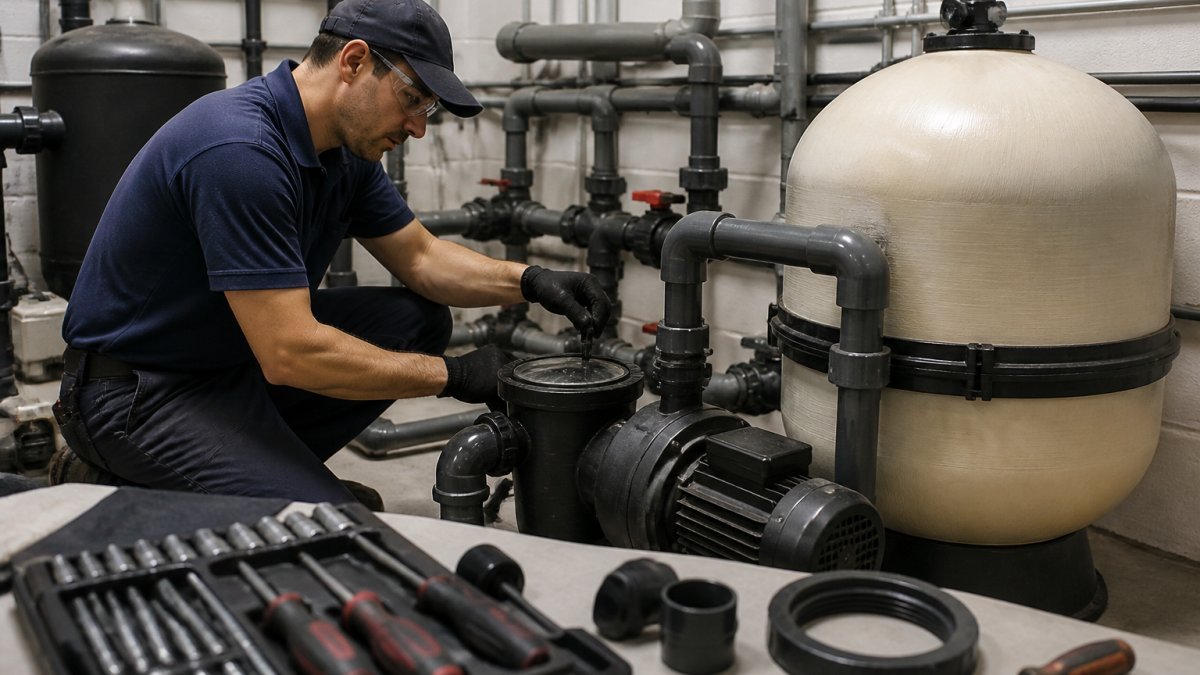
Preventive maintenance catches problems before failure occurs, including monthly pump inspections, quarterly filter cleanings, heater efficiency checks, and pressure gauge monitoring.
Reynolds Pool Service inspects equipment during every service visit, looking for wear, corrosion, or reduced performance.
Watch Out: Deferred equipment maintenance creates compounding costs. A $200 bearing replacement becomes a $2,000 pump replacement if ignored. A $300 filter cleaning becomes a $5,000 filter replacement. Document all maintenance performed so you can track equipment age and condition.
Creating a Commercial Pool Maintenance Checklist
A structured maintenance checklist ensures nothing gets overlooked and provides documentation regulators may request.
Daily tasks include water testing, visual equipment inspection, and debris removal. Weekly tasks include filter backwashing, tile and wall cleaning, and detailed equipment checks.
The checklist creates accountability between property manager and service provider, documents compliance with health department standards, provides a record if liability issues arise, and tracks when equipment was last serviced to help predict major repairs or replacement.
| Task | Frequency | Responsibility | Compliance Reason |
|---|---|---|---|
| Water chemistry testing | Daily | Service technician | Health department requirement |
| Debris removal | Daily to twice daily | Service technician or staff | Water clarity and equipment protection |
| Filter inspection | Weekly | Service technician | Equipment efficiency and water quality |
| Equipment pressure check | Weekly | Service technician | Early detection of filter or pump issues |
| Calcium hardness test | Monthly | Service technician | Prevents scaling or corrosion |
| Pump bearing inspection | Monthly | Service technician | Prevents catastrophic equipment failure |
| Heater efficiency test | Quarterly | Service technician | Energy efficiency and safety |
Documentation, Records, and Compliance Reporting
Most service pages mention “detailed reporting” and stop there. For a property manager overseeing shared pools, documentation is the operating system: it’s how you prove compliance, defend against claims, evaluate your vendor, and hand off a property without losing institutional knowledge. Build the file deliberately rather than accepting whatever PDF the technician emails over.
What belongs in the compliance file
A defensible record set for each pool typically includes:
- Daily water chemistry logs, free chlorine and combined chlorine, pH, total alkalinity, calcium hardness, cyanuric acid (where used), and water temperature, each with date, time, reading, and the name of the person who tested.
- Chemical addition records, product name, amount, and time applied, tied to the test result that triggered the dose.
- Equipment inspection and maintenance notes, pump, filter, heater, chemical feeder, safety equipment, and any corrective action taken.
- Repair and work-order history, what failed, what was replaced, part numbers where available, and who performed the work.
- Incident and closure records, contamination events, fecal or vomit incidents, injuries, emergency closures, and the response timeline.
- Safety documentation, drain cover inspection and replacement dates, entrapment-prevention compliance, signage condition, and lifeguard or attendant coverage where required.
- Inspector correspondence, inspection reports, citations, corrective-action plans, and re-inspection results.
Retention and access
Retention periods are set by state and local health codes and vary widely; some jurisdictions require records on site and available on demand, while others allow off-site storage. Confirm the specific requirement with your local health department rather than assuming a national rule.
Digital logs are worth the switch: searchable records let you answer an inspector in seconds, spot a drifting pH trend before it becomes a closure, and produce a clean history when a resident or guest alleges illness. Paper binders get lost during staff turnover; cloud records survive it.
What a usable service report contains
A service report that actually supports management should show, at minimum:
- Date, arrival and departure times, and technician name and certification number.
- Every chemistry reading with the target range and pass/fail status.
- Chemicals added and quantities.
- Equipment observed, with any anomalies flagged and photographed.
- Tasks completed against the contracted checklist.
- Open issues, recommended repairs, and whether they are urgent.
- A signature or timestamped digital acknowledgment.
If your provider’s reports are a one-line “pool serviced” text, you have no compliance trail and no leverage to evaluate performance.
Using records during an inspection
When an inspector arrives, the records do most of the talking. Keep the current log, chemical records, equipment maintenance history, and drain-cover documentation in one place the on-site manager can reach without calling the vendor, and walk the inspector through the log rather than handing over a box.
CDC’s public pool and spa water quality guidelines and your state health department’s pool code are the two references to keep handy when building the file structure; the CDC guidance frames the health basis, and the state code sets the actual record and inspection requirements you will be held to.
Watch Out: Do not let the service provider be the sole custodian of your compliance records. If the contract ends, the records should stay with the property. Require monthly export of logs and reports in a format you can open without the vendor’s software.
Key Takeaway: Treat documentation as a management deliverable, not a vendor courtesy. Specify the fields, retention period, access method, and export format in the contract, and audit a sample of reports each quarter.
Choosing a Reliable Commercial Pool Service Provider
Not all pool service companies have experience managing commercial facilities.
When evaluating service providers, ask about certifications. Certified Pool Operators (CPO) have passed exams on water chemistry, equipment operation, and health regulations. They understand commercial standards in ways that residential-only technicians may not.
Reliability matters tremendously. A provider who misses appointments or fails to complete work creates problems for property managers.
Pricing should be transparent and based on facility size, usage patterns, and specific needs rather than vague estimates.
Pool and Spa Alliance certification standards provide guidelines for evaluating service provider qualifications and practices.
Key Takeaway: The best service provider combines certified technicians, transparent communication, reliable scheduling, and detailed documentation. They understand your facility’s specific needs and proactively address issues before they become problems.
Conclusion
Commercial pool maintenance for property managers requires a systematic approach balancing water safety, equipment reliability, regulatory compliance, and guest satisfaction. The difference between adequate maintenance and exceptional management comes down to consistent service, detailed documentation, and providers who understand commercial operations.
Reynolds Pool Service specializes in commercial pool maintenance across diverse facility types, providing certified technician expertise, comprehensive water chemistry management, equipment inspection and repair, and detailed service documentation that keeps your facility compliant and operational. Request a free quote to discuss how we can simplify your commercial pool management.
Frequently Asked Questions
What does commercial pool maintenance include?
Commercial pool maintenance includes routine cleaning, debris removal, water testing, chemical balancing, equipment inspection, pump and filter servicing, heater maintenance, and tile cleaning. Property managers should also expect preventive maintenance checks to catch equipment issues before they become costly repairs, plus documentation of all service activities for compliance and liability purposes.
How often should a commercial pool be serviced?
Most commercial pools require service 1-3 times per week depending on usage, bather load, and local health codes. High-traffic facilities like hotels or fitness centers may need daily monitoring. A qualified service provider will recommend a schedule based on your specific property type, usage patterns, and regulatory requirements in your area.
What should be on a commercial pool maintenance checklist?
A comprehensive checklist should include water pH and sanitizer testing, debris skimming and vacuuming, filter backwashing, pump and heater operation verification, tile and surface inspection, equipment visual checks, drain and circulation system review, and documentation of all tasks performed. This checklist protects your property, ensures guest safety, and provides evidence of compliance with health department regulations.
How can property managers tell when commercial pool equipment needs repair?
Watch for reduced water flow, unusual pump noises, heater temperature inconsistencies, cloudy water despite chemical balance, visible corrosion or leaks, and filter pressure readings above normal operating range. A qualified service provider performs monthly equipment inspections to identify these issues early. Prompt repairs prevent equipment failure, reduce liability risk, and avoid expensive emergency service calls.
What records should property managers keep for pool maintenance?
Maintain a log of all service dates, chemical test results, equipment repairs, parts replaced, technician names, and any issues observed. Keep copies of service invoices, equipment warranties, and compliance inspection reports. This documentation demonstrates due diligence to liability insurers, supports regulatory inspections, and helps track maintenance trends and budgeting over time.
How much does commercial pool maintenance cost, and is it cheaper to do it in-house?
Professional commercial pool maintenance pricing depends on pool size, usage frequency, location, and service scope. While DIY chemical purchases may seem cheaper initially, professional service includes certified technician expertise and compliance documentation, costs that DIY maintenance cannot offset. Professional service reduces liability risk and ensures regulatory compliance, making it the safer choice for commercial properties.
Authoritative Reference
For additional guidance, see California public-pool operation record requirements (Title 22 text). The source supports general principles; specific service procedures should still follow the equipment manufacturer and local requirements.
Explore our High Desert pool services for on-site help.