Pool heater repair cost depends on whether the issue is a flow restriction, sensor, ignition component, control board, heat exchanger, or the installation itself. This guide separates diagnostic charges, parts, and labor so homeowners can compare repair estimates with replacement options.
Table of Contents
- Pool Heater Repair Cost Ranges
- Understanding Pool Heater Repair Cost Breakdown
- Pool Heater Repair vs Replacement: When to Fix or Replace
- Pool Heater Troubleshooting: What You Can Check First
- Getting an Accurate Pool Heater Repair Estimate
- Factors That Affect Pool Heater Repair Pricing
- Protecting Your Investment: Warranty and Prevention
- Frequently Asked Questions
Last Updated: October 17, 2026
Pool Heater Repair Cost Ranges
Pool heater repair pricing varies dramatically depending on what’s broken, which type of heater you own, and where you live. Understanding the typical cost ranges helps you decide whether to repair or replace when your heater fails.
Most pool heater repairs fall between $160 and $730, with a typical repair averaging around $479. According to Swimply’s 2026 Pool Heater Cost Guide, diagnostic visits alone typically run $125 to $195 before any actual repair work begins.
Typical repair costs by heater type
Gas heaters tend to cluster in the lower to mid-range of repair costs, often between $175 and $600 for common failures like ignition problems or burner issues.
The specific heater model matters too. A 400,000 BTU natural-gas heater repair differs significantly from a smaller residential unit. Older equipment costs more to fix because replacement parts become harder to source, and technicians may need extra time troubleshooting systems that lack modern diagnostics.
What affects your final bill
Your actual repair bill depends on several moving parts beyond just the broken component.
Emergency service carries a premium. A heater that fails on a weekend or during peak season costs more than the same repair scheduled during off-hours on a weekday.
Parts availability impacts cost directly. Common components like thermostats or pressure switches ship quickly and cost less.
Understanding Pool Heater Repair Cost Breakdown
Breaking down what you actually pay reveals why repair estimates vary so much. The total bill combines several distinct charges that stack up quickly.
Diagnostic fees and service calls
Most technicians charge a diagnostic fee just to show up and identify the problem. This typically runs $125 to $195 and covers the service call itself, the technician’s time to inspect your heater, run tests, and determine what’s wrong.
The diagnostic fee is non-negotiable in most cases, even if the repair is simple. Technicians need to cover their travel time and the cost of maintaining their vehicle and equipment.
Labor versus parts pricing
Labor typically represents 40-60% of your final repair bill. Technicians charge hourly rates ranging from $75 to $150 per hour depending on location and expertise. A straightforward repair might take one hour; a complex job involving multiple components can stretch to three or four hours.
Parts themselves vary wildly in cost. A replacement thermostat runs $50 to $200. A new heat exchanger can cost $300 to $800. Control boards and compressors push into the $400 to $1,200 range.
Emergency and seasonal surcharges
Calling a technician on a Saturday, Sunday, or holiday typically adds 25-50% to your bill. A $400 repair becomes $500 to $600 when it happens outside standard business hours.
Some companies charge minimum service call fees of $150 to $250, meaning even a quick 15-minute fix costs at least that amount. Always ask about minimum charges when you call for an estimate.
Pool Heater Repair vs Replacement: When to Fix or Replace
The hardest decision comes when facing a substantial repair bill: should you fix the heater or replace it entirely? A practical rule guides this choice.
The 50% replacement rule
The 50% rule states that if a repair costs more than 50% of a new heater’s installed price, replacement makes financial sense. According to Adams Pool & Spa’s 2026 Repair vs Replace Guide, an installed replacement heater typically ranges from $3,500 to $5,500.
This rule isn’t absolute, it’s a starting point. A $2,000 repair on a heater that’s only three years old might still make sense. A $1,500 repair on a 12-year-old unit probably doesn’t.
Pro Tip: Ask your technician how many years of useful life remain in your current heater. A heater nearing the end of its typical 10-15 year lifespan is a better candidate for replacement than a newer unit with decades of potential service ahead.
Heater age and remaining lifespan
Most pool heaters last 10 to 15 years with proper maintenance. Once a heater passes the 12-year mark, major repairs become increasingly common.
Conversely, a heater that’s only five years old and experiencing its first significant failure is usually worth repairing. You’re getting back years of reliable service for a one-time investment.
Consider the energy efficiency angle too. Older heaters operate less efficiently than modern units, so a replacement heater reduces your monthly heating costs immediately.
Pool Heater Troubleshooting: What You Can Check First
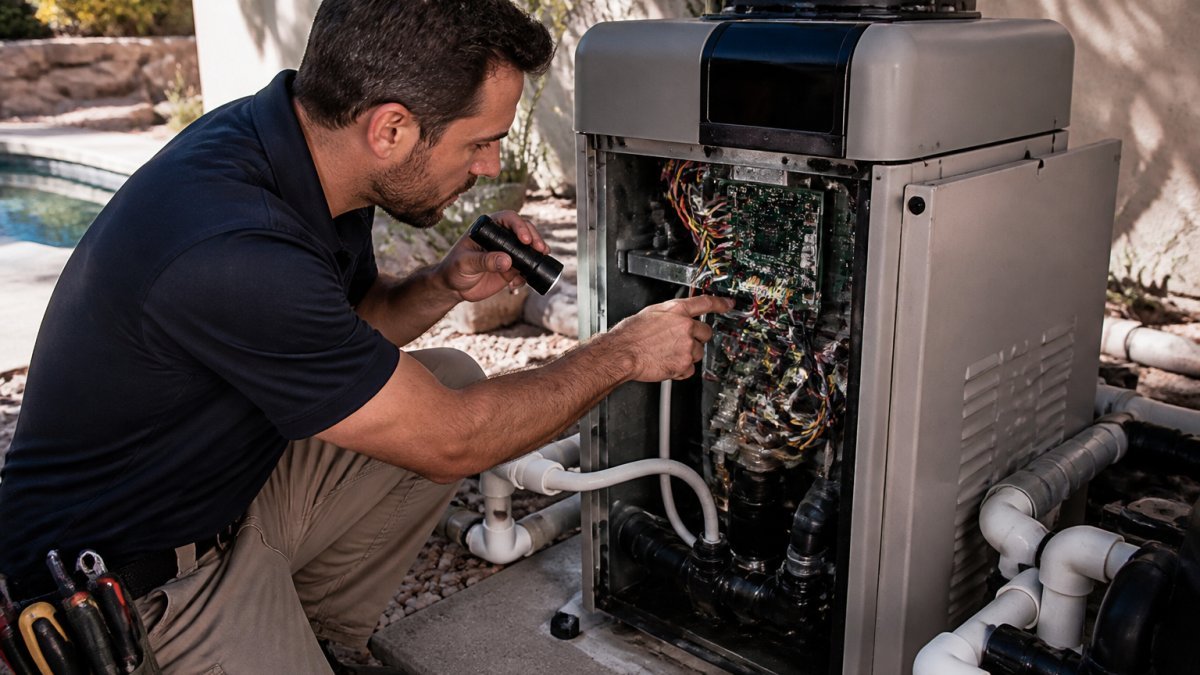
Before calling a technician and paying a diagnostic fee, you can perform basic troubleshooting to identify obvious problems. This knowledge also helps you ask smarter questions when you do call for service.
Common problems and quick diagnostics
A heater that won’t start often points to simple issues.
Temperature not rising suggests either insufficient water flow or a failing thermostat. Check that your pool pump is running and the filter isn’t clogged.
Strange noises like grinding or squealing indicate mechanical wear. Hissing sounds suggest a refrigerant leak in heat pump systems.
Visible corrosion, rust, or water pooling around the heater indicates structural failure or leaks. Document what you see with photos to show the technician.
Safety boundaries for DIY troubleshooting
Never attempt to open the heater cabinet or access internal components yourself. Gas heaters involve combustion systems and pressurized gas lines, improper handling creates fire and explosion hazards. Electric heaters contain high-voltage components that cause serious injury or death.
Your safe troubleshooting stops at checking external connections, verifying power and water flow, and noting visible damage. Everything beyond that is the technician’s domain. Attempting internal repairs voids warranties and creates liability if something goes wrong.
Getting an Accurate Pool Heater Repair Estimate
A solid repair estimate gives you confidence in the quoted price and helps you compare quotes from different technicians.
What to ask your service technician
Request a written estimate that itemizes labor hours and specific parts being replaced. Ask whether the diagnostic fee applies toward the repair cost or stands separately.
Ask about timeline: how long until parts arrive if they’re not in stock, and when the work can be scheduled.
Get clarity on what’s included in the estimate. Does it cover testing after the repair to confirm the heater works properly?
Regional pricing and local labor rates
Pool heater repair costs vary significantly by region. High-cost areas like California, New York, and Florida see labor rates 30-50% higher than rural regions.
When comparing estimates from different technicians, account for these regional differences.
Call multiple technicians in your area to establish what’s typical. This competitive intelligence protects you from overpaying while ensuring you hire qualified professionals.
Factors That Affect Pool Heater Repair Pricing
Several variables compound to create your final repair bill. Understanding them helps you anticipate costs and make informed decisions.
Heater type: gas, electric, heat pump, and solar
Gas heaters are generally the cheapest to repair because parts are widely available and technicians encounter them frequently. Electric heaters cost more due to specialized electrical components and the expertise required.
Solar heaters present unique challenges. Parts are harder to source, and fewer technicians specialize in them. A solar heater repair that would be routine on a gas system becomes expensive simply due to parts availability and technician scarcity.
Pool size and heating capacity requirements
Larger pools require more powerful heaters, which means larger components and higher replacement costs. A 400,000 BTU heater costs more to repair than a 200,000 BTU unit simply because the parts are larger and more expensive.
Pool size also affects how quickly problems develop. Undersized heaters work harder and fail sooner. A heater matched to your pool’s volume operates more efficiently and lasts longer.
Parts availability and equipment age
Modern heater models have readily available parts, keeping repair costs down. Older or discontinued models create sourcing challenges that drive costs up. A 15-year-old heater might require weeks to locate a replacement part, extending your repair timeline and labor costs.
Manufacturer support matters too. Some heater brands maintain parts availability for decades; others discontinue support after a few years. Knowing your heater’s brand and model helps technicians assess parts availability before quoting the repair.
Protecting Your Investment: Warranty and Prevention
Reducing repair frequency starts with understanding warranty coverage and committing to preventive maintenance.
Warranty coverage for repairs and parts
Most heater repairs come with a labor warranty of 30 to 90 days. If the same problem recurs within that window, the technician typically fixes it at no charge.
Always request warranty terms in writing. Understand what’s covered and for how long. A longer warranty reflects the technician’s confidence in their work.
New heater installations typically include manufacturer warranties covering defects for one to five years, depending on the heater type. Read your warranty documentation carefully.
Preventive maintenance to avoid costly repairs
Regular maintenance is the most cost-effective strategy for extending heater life and preventing expensive failures. Seasonal inspections before heating season catch problems early. Annual professional servicing keeps components clean and functioning efficiently.
Simple tasks like checking water flow, verifying thermostat accuracy, and inspecting visible components for corrosion take minutes but prevent major issues.
Key Takeaway: The most expensive pool heater repair is the one you could have prevented. A $200 annual maintenance visit saves thousands in emergency repairs down the road.
| Repair Type | Typical Cost Range | Labor Time | Parts Cost |
|---|---|---|---|
| Thermostat replacement | $150-$300 | 0.5-1 hour | $50-$200 |
| Ignition system repair (gas) | $200-$500 | 1-2 hours | $100-$300 |
| Control board replacement | $300-$700 | 1-2 hours | $200-$500 |
| Heat exchanger replacement | $600-$1,200 | 2-3 hours | $300-$800 |
| Compressor replacement (heat pump) | $800-$1,500 | 2-4 hours | $400-$1,000 |
| Complete heater replacement | $3,500-$5,500 | 4-6 hours | $2,500-$4,500 |
Unexpected heater failures happen, but understanding repair costs and your options removes the shock. When your heater stops working, you’ll know whether a repair makes financial sense or if replacement is the smarter choice. Request a free quote
Frequently Asked Questions
How much does it cost to repair a pool heater?
Pool heater repair costs typically range from $160 to $802, with an average around $479 according to industry benchmarks. The final cost depends on the specific problem, heater type, and your location. Diagnostic visits alone run $125-$195. Common repairs like thermostat or ignition system fixes fall on the lower end, while heat exchanger or control board replacement can exceed $600. Request a service call for an accurate estimate based on your heater’s condition.
Is it cheaper to repair or replace a pool heater?
A practical rule: if the repair costs more than 50% of a new heater’s installed price, replacement often makes financial sense. New heaters typically cost $3,500-$5,500 installed, so repairs exceeding $1,750-$2,750 warrant replacement consideration. Also factor in heater age, units over 10-15 years old may fail again soon after repair. Compare the single repair cost against your heater’s remaining lifespan and energy efficiency gains from a newer model before deciding.
What should a pool heater repair estimate include?
A complete repair estimate should list the diagnostic fee, the specific problem identified, parts needed with individual costs, labor hours and hourly rate, travel or service-call charges, and any warranty on parts or labor. It should also note whether the estimate is binding or if additional costs might arise during repair. Ask about emergency surcharges if you’re calling outside business hours, and confirm the timeline for parts availability if components must be ordered.
Can I troubleshoot a pool heater before calling a technician?
Yes, check a few basics first: verify the heater has power and the breaker isn’t tripped, confirm water is flowing through the system, check that the thermostat is set correctly, and look for visible leaks or corrosion. Listen for unusual sounds or smell for gas leaks, if you detect gas, leave the area and call immediately. However, stop there. Electrical components, gas lines, heat exchangers, and refrigerant systems require professional tools and training. Attempting repairs beyond basic checks risks injury and voids warranties.
What factors most affect pool heater repair pricing?
The heater type (gas, electric, heat pump, or solar) significantly influences cost, heat pumps and solar systems often cost more to repair than simple gas heaters. Pool size and heating capacity matter because larger heaters have bigger components and higher replacement costs. Parts availability affects timeline and labor hours; older heaters may require special-order parts. Your location’s local labor rates and seasonal demand also play a role, emergency off-season calls typically carry surcharges.
Explore our High Desert pool services for on-site help.