Last Updated: October 25, 2026
Quick Summary
Pool maintenance costs versus DIY chemicals only compare fairly on an annual, like-for-like basis that includes chemicals, testing supplies, tools, equipment wear, mistake risk, and your own labor hours. Once DIY labor is priced honestly, the DIY total often lands close to a professional service quote for the same pool.
- Chemical dosing scales with water volume, so two similar pools can differ in cost by a factor of two or more.
- A full DIY clean takes roughly one to two hours for an average pool, and testing plus dosing adds more.
- Build your chemical budget as a seasonal curve, then average peak-summer and low-season figures across twelve months.
- Start with a good testing kit and basic cleaning tools before buying a full tool kit or robotic cleaner.
- Incorrect dosing can cloud water, scale equipment, or trigger an algae bloom that erases months of DIY savings.
Table of Contents
- The Real Trade-Off: Money, Time, and Water Quality
- Pool Maintenance Cost Per Month: What Professional Service Actually Covers
- Pool Chemicals Cost Per Month: The DIY Line Item Most Owners Underestimate
- Upfront Costs of Going DIY: Tools, Testing, and Water Testing Kits
- Pool Maintenance Time Per Week: The Hours You Are Really Spending
- DIY Pool Maintenance Checklist: What a Full Week of Care Looks Like
- Unexpected Costs and the Risk of Maintenance Mistakes
- A Like-for-Like Annual Cost Comparison
- Frequently Asked Questions
The Real Trade-Off: Money, Time, and Water Quality
Pool maintenance costs vs DIY chemicals comes down to one question: are you paying for chemicals, or for someone else’s time, testing discipline, and equipment knowledge?
That comparison is incomplete. A pool is a small chemical plant running seven days a week, and the real cost of DIY includes testing supplies, dosing mistakes, replacement parts, and the hours spent skimming dust after a wind event.
Pool Maintenance Cost Per Month: What Professional Service Actually Covers
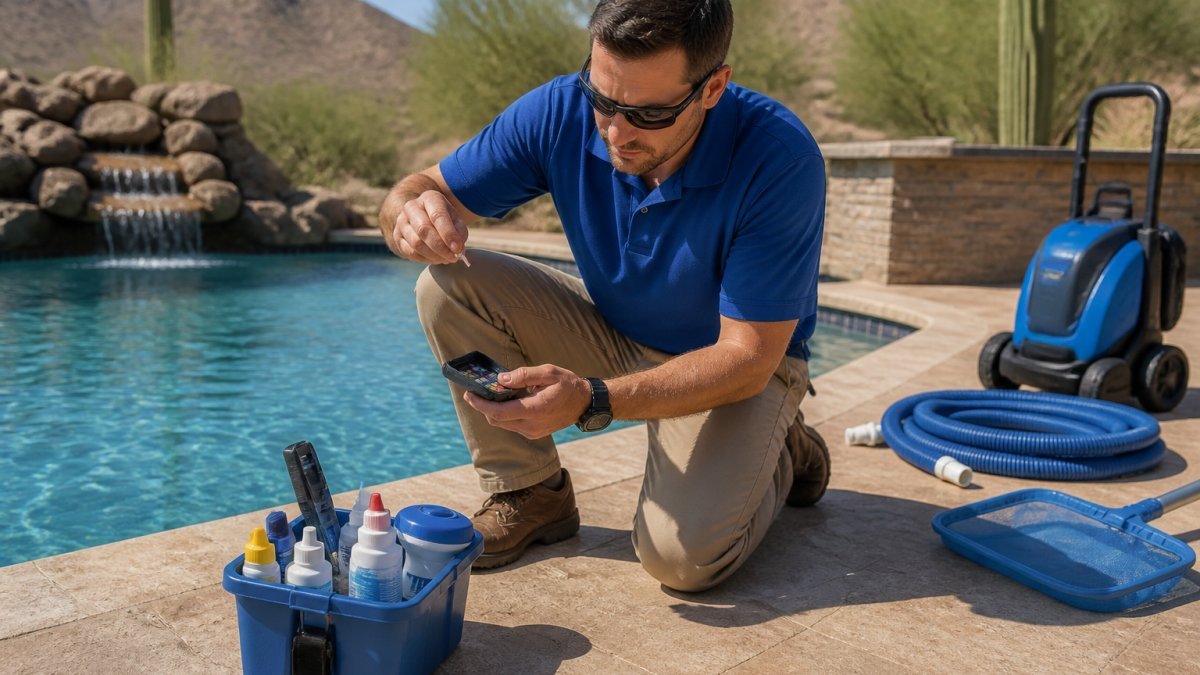
Professional pool service is a recurring fee bundling water testing, chemical dosing, skimming, brushing, vacuuming, filter cleaning, and equipment checks into one visit. The monthly figure depends on pool size, debris load, and visit frequency, so we quote each property individually.
Why Service Quotes Vary So Much
Two pools of identical size can carry very different monthly costs. A screened pool in a sheltered yard needs less debris work than an open pool downwind of a dirt lot. Saltwater systems, spas, and water features add chemistry and equipment time, and twice-weekly service costs more than weekly but catches problems earlier.
Weekly Visits, Filter Cleaning, and Equipment Checks
A typical visit follows a fixed sequence: test chemistry, dose chemicals, skim the surface, brush walls and steps, vacuum as needed, empty baskets, and inspect the pump, filter, and heater. Filter cleaning happens on a schedule rather than every visit. For proper equipment care between visits, see our guide to best practices for pool equipment care.
Pool Chemicals Cost Per Month: The DIY Line Item Most Owners Underestimate
DIY chemical costs are the most misjudged number in pool ownership. Owners budget for chlorine and shock, then discover pH adjusters, alkalinity buffers, calcium hardness increaser, stabilizer, and algaecide add up fast. A pool is a continuous chemical reaction, and every input must be replaced as it is consumed, off-gassed, or diluted by splash-out and backwashing.
The Line Items Behind a Monthly Chemical Bill
A DIY chemical budget is not one number. It is a stack of recurring purchases, each driven by a different variable:
- Sanitizer (chlorine tabs, liquid chlorine, or granular shock). The largest recurring line. Demand rises with sunlight hours, water temperature, bather load, and the amount of organic debris in the water. In intense-sun climates, chlorine burn-off can be two to three times the winter rate.
- pH adjusters (muriatic acid or soda ash). Needed whenever sanitizer addition or source-water alkalinity pushes pH out of the 7.2-7.8 range. Plaster pools and saltwater pools tend to need acid more often.
- Total alkalinity buffer (sodium bicarbonate). Prevents pH bounce. Usually a smaller line, but a large correction after a partial drain or heavy rain can be a one-time spike.
How Pool Volume Drives Dose Size
Chemical dosing scales with water volume, not visit count. A large inground pool can hold several times the water of a small fiberglass pool, and every dose, chlorine, acid, buffer, hardness, scales proportionally.
To estimate your own line, read the label dose rate on each product (for example, ounces per 10,000 gallons), multiply by your pool’s volume in tens of thousands of gallons, then by how often you actually dose.
Chemical Costs by Pool Type
- Plaster / concrete pools. Highest acid and hardness demand. New plaster in its first year can consume significant acid and hardness increaser as the surface cures.
- Vinyl and fiberglass pools. Lower hardness demand because the surface does not leach calcium the same way, but pH and alkalinity still need routine management.
- Saltwater pools. Chlorine is generated on-site, so the sanitizer line shifts from jugs of chlorine to salt, cell replacement, and more muriatic acid for pH control. The monthly chemical bill can look lower while the amortized equipment bill is higher.
Summer Chemical Costs and Seasonal Swings
Chemical spend is not flat across the year. Summer brings longer sunlight hours, warmer water, heavier bather load, and faster chlorine burn-off, so dosing frequency climbs. Winter demand drops, but sanitizer and balance still need maintaining, a pool “closed” in a mild climate still consumes chlorine, just more slowly. Owners who budget one monthly figure year-round overspend in winter and run short in July.
Build your chemical budget as a seasonal curve, not a flat monthly number. Estimate a peak-summer monthly figure and a low-season figure, then average them across twelve months. That average is the number to compare against a service quote.
For a practical walkthrough of balancing water yourself, see our guide on how to balance pool water chemistry.
Upfront Costs of Going DIY: Tools, Testing, and Water Testing Kits
Going DIY carries a startup cost before you touch a single chemical. A reliable water testing kit comes first; test strips are cheaper but less precise.
Watch out: buying a full tool kit before you have tested your own commitment is the most common wasted spend we see. Start with a good testing kit and basic cleaning tools, then add equipment once the routine sticks.
Pool Maintenance Time Per Week: The Hours You Are Really Spending
Pool maintenance time per week is the hidden cost of DIY, and it is larger than most owners expect. A full clean takes roughly one to two hours for an average pool, and testing plus dosing adds more. After a dust storm, that time can double.
Valuing Your Own Labor
Your time has a number even if no one invoices you for it. Multiply your weekly hours by your own hourly value, then add it to your chemical and tool spend. Many owners find the DIY total lands close to professional service once labor is priced honestly.
DIY Pool Maintenance Checklist: What a Full Week of Care Looks Like
A realistic DIY week is more than a quick skim. Use this checklist to see the actual workload before you commit:
- Test pH, chlorine, alkalinity, and calcium hardness twice weekly
- Dose chemicals based on test results, not a fixed schedule
- Skim the surface and empty baskets every one to two days
Unexpected Costs and the Risk of Maintenance Mistakes
Mistakes carry real financial consequences. Out-of-balance chemistry can scale equipment, cloud water, and shorten the life of a heater or salt cell. Our guide on preventing algae in high desert pools explains why this failure mode is so common here.
Emergency repairs compound the problem. A failed pump or heater discovered late usually costs more than routine service would have, and the failure often traces back to chemistry or filtration neglect.
A Like-for-Like Annual Cost Comparison
Annualizing both options sharpens the picture, and is where most comparisons fall apart. Comparing a monthly service invoice against a monthly chemical receipt is not like-for-like. A fair comparison puts the same categories on both sides for a full twelve months, states the assumptions behind every range, and prices the owner’s time.
The Assumptions That Drive Every Estimate
No annual figure is meaningful without its assumptions. Before comparing, pin down these variables:
- Pool size (gallons). Drives chemical dose size, filter run time, and service pricing.
- Pool type and surface. Plaster, vinyl, and fiberglass differ in hardness and acid demand; saltwater shifts cost from chlorine to cell replacement.
- Climate and season length. A long swimming season means more chlorine months and more service visits; a short season concentrates cost into fewer months plus opening and closing.
State these six assumptions next to any quote or budget, and the comparison becomes honest. Omit them, and two owners can argue about “the cost of a pool” while describing completely different pools.
The Annual Ledger, Side by Side
| Cost Category | DIY (annual) | Professional Service (annual) |
|---|---|---|
| Chemicals (all four seasons) | Owner purchases; scales with volume and season | Typically bundled into the service fee |
| Testing supplies | Test kit plus reagent refills or strips | Included in the visit |
| Cleaning tools | Pole, brush, net, vacuum, hose; replacement as they wear | Owner owns; service uses and maintains |
| Equipment wear and replacement | Owner bears full cost, including premature failure | Owner bears cost, but consistent chemistry tends to extend life |
| Filter cleaning and backwashing | Owner’s time and water | Included in the visit |
| Owner labor | Weekly hours, valued at the owner’s rate | Minimal, scheduling and oversight only |
| Mistake and repair risk | Higher when testing is inconsistent | Lower with disciplined testing |
| Time cost | Significant and recurring | Small |
The point is not that one column wins. It is that the DIY column contains several lines, labor, tool replacement, mistake risk, that owners routinely leave at zero when comparing a jug of chlorine to an invoice.
Valuing DIY Labor Honestly
This is the line most comparisons skip. Track your actual weekly maintenance time for a month: testing, dosing, skimming, brushing, vacuuming, filter checks, and chemical runs.
A common pattern: once labor is priced realistically, the DIY total lands close to a professional service quote for the same pool, sometimes above it in peak season, when chemical demand and cleaning time both rise.
The honest comparison is not “chemicals versus invoice.” It is “chemicals plus tools plus equipment wear plus mistake risk plus your hours” versus “service fee plus the repairs that still happen.” Put both on an annual basis with the same assumptions, and the gap narrows.
The Costs That Do Not Show Up on Either Receipt
Two categories sit outside the monthly math but belong in the annual comparison:
- Mistake costs. Incorrect dosing can cloud water, scale equipment, or trigger an algae bloom that takes weeks and multiple purchases to reverse. One corrective event can erase months of DIY savings.
- Deferred-maintenance costs. A pump or heater that fails early from neglected chemistry or filtration usually costs more than the routine service that would have prevented it. These failures are irregular, exactly why they get left out of monthly comparisons, and why they belong in an annual one.
For the full price breakdown on both sides, read our comparison of pool service monthly cost vs DIY, and for the chemistry effort side specifically, see DIY pool chemistry vs professional service.
Frequently Asked Questions
Is it cheaper to maintain a pool yourself or hire a pool service?
On chemicals alone, DIY usually comes out lower, but the gap narrows once you add testing supplies, replacement brushes and vacuums, electricity for longer pump runs, and the value of your own weekend hours. Professional service bundles chemicals, routine cleaning, and early problem detection into one predictable bill. The cheaper option depends on your pool size, how heavily it is used, and whether you want to spend several hours a week on upkeep or hand it off.
How much do pool chemicals cost per month?
Chemical spend rises with pool size, bather load, and heat. A smaller pool kept balanced year-round typically costs less than a large inground pool in full summer sun, where chlorine burns off faster and shock is needed more often. Saltwater pools shift cost from chlorine to the salt cell and occasional acid, so the monthly total can look different from a traditional chlorine pool. Track your own receipts for two months to get a real number for your pool.
How much time does DIY pool maintenance take each week?
Plan on two to four hours per week in summer: skimming debris, brushing walls, vacuuming, emptying baskets, testing and dosing water, and checking the filter. Winter takes less, but debris storms and algae blooms can double the time. If your schedule is tight, that weekly block is the real cost of DIY, not the chemicals.
How often should a pool be serviced?
Most residential pools do well on a weekly service visit, with filter cleaning and equipment checks on a monthly or quarterly rhythm depending on debris load. Pools in dusty, windy areas or with heavy bather traffic may need more frequent attention. Commercial pools often require more visits than residential ones. Ask for a written visit schedule so you know exactly what is included.
The honest answer is that DIY only wins on paper when you leave out your own hours and the cost of mistakes. If you want balanced water, working equipment, and weekends back, George Reynolds Pool Service handles testing, dosing, filter cleaning, and equipment checks on a schedule built for your pool. We also specialize in tile cleaning and pool automation for owners who want less hands-on work. Request a free quote and get a clear monthly number for your property.
