Table of Contents
- Why Keeping Your Pool Clean Matters in the Desert
- Essential Pool Cleaning Tools You’ll Need
- Your Weekly Pool Maintenance Checklist
- Water Chemistry: Testing and Balancing
- How to Clear Cloudy Pool Water
- Pool Pump Run Time and Equipment Care
- Seasonal Pool Care for the High Desert
- When to Call a Professional Pool Service
- Frequently Asked Questions
Last Updated: October 21, 2026
Why Keeping Your Pool Clean Matters in the Desert
Learning how to keep pool clean in Victorville isn’t optional, it’s essential. The high desert climate brings intense sun, dust storms, and temperature swings that assault your water chemistry daily. Without consistent care, your pool becomes a breeding ground for algae and equipment failure.
The desert environment accelerates algae growth and mineral buildup. Your pool needs weekly attention to stay safe and swimmable.
Here’s what most pool owners get wrong: they treat cleaning as something to do when the water looks bad. By then, you’re fighting an uphill battle. The real approach is prevention through routine maintenance.
Start your pool season by testing water chemistry before adding any chemicals. Many owners waste money treating problems that don’t exist yet.
A clean pool protects your family and extends equipment life. It also keeps your backyard enjoyable year-round. The good news? Keeping your pool clean doesn’t require expensive professional help every week, though we’re here when you need us.
Essential Pool Cleaning Tools You’ll Need
You don’t need a truckload of gear to keep pool clean.
Telescoping skimmer net (16-21 ft pole): Removes leaves, bugs, and surface debris before it sinks. Look for a deep-bag net with a reinforced rim; shallow nets dump debris back into the water when you lift them.
Nylon-bristle pool brush (18 in. wide): Scrubs walls, steps, and the waterline to break up algae before it anchors.
Vacuum head and hose: Cleans the floor. A weighted vacuum head plus a 30-40 ft hose connects to your skimmer or a dedicated vacuum port.
Manual test kit or test strips: Tests chlorine, pH, and alkalinity. Liquid drop kits are more accurate than strips and are the better choice if you’re learning water chemistry; strips are faster for daily checks.
Chlorine source and pH adjusters: Stabilized chlorine tablets (trichlor) in a floating dispenser ($10-$20) work for steady maintenance, while liquid chlorine (sodium hypochlorite) is better for shock and quick recovery.
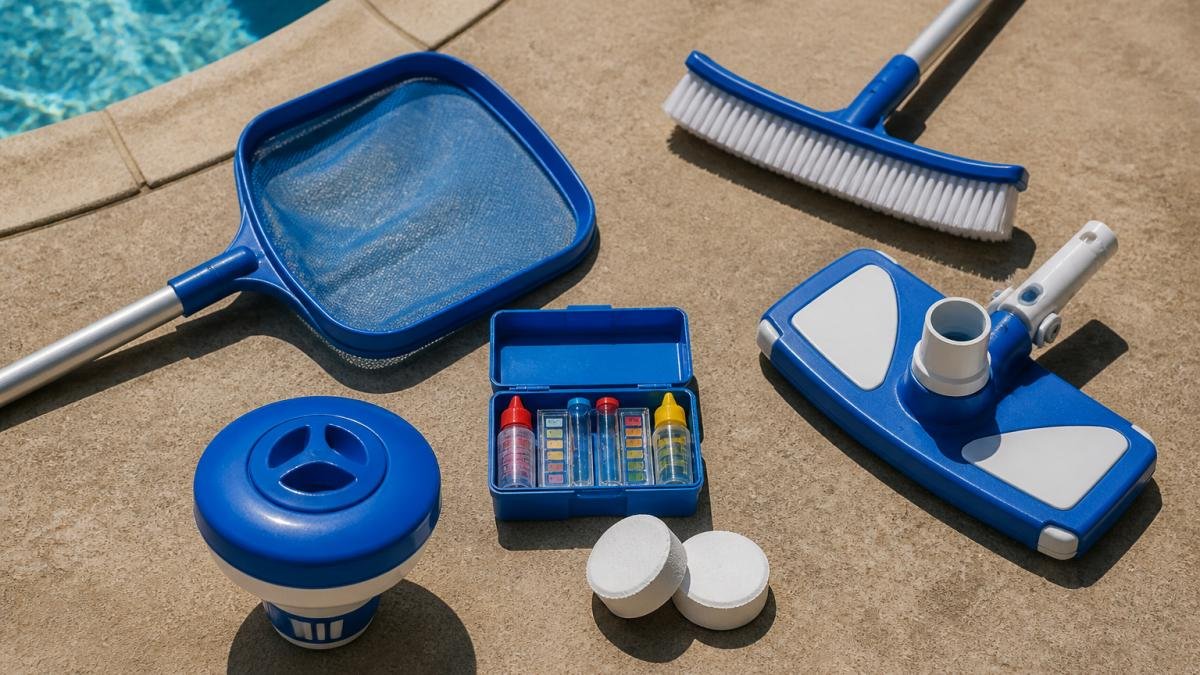
Start with the six core items and add tools only when a specific problem shows up.
Buy a pole that extends at least two feet longer than the deepest part of your pool. Short poles force you to lean over the edge, which is how most back strains and accidental dunks happen.
Your Weekly Pool Maintenance Checklist
Keeping pool clean requires a system. Weekly maintenance prevents big problems. Break it into daily tasks and a deeper weekly routine.
Daily tasks (5-10 minutes)
Do these every day during pool season:
- Skim the surface for leaves and debris
- Check water level (should be halfway up the skimmer opening)
- Run the pump for 8-12 hours minimum
- Look for visible algae or cloudiness
That’s it. Five minutes prevents most problems.
Weekly deep-clean steps
Once per week, add 30-45 minutes to your routine:
-
Test water chemistry. Check chlorine (1-3 ppm), pH (7.2-7.6), and alkalinity (80-120 ppm). Write down results to spot trends.
-
Adjust chemicals as needed. Add chlorine if levels are low. Raise pH with soda ash if it’s below 7.2. Lower pH with muriatic acid if it’s above 7.8.
-
Brush walls and floor. Scrub corners and steps where algae hides. Pay extra attention to shaded areas.
-
Vacuum the floor. Use your vacuum head to remove settled debris.
-
Empty skimmer baskets. Clean out the basket in your skimmer and pump strainer.
-
Backwash the filter. If you have a sand filter, reverse the flow to clean it. Run until water runs clear.
The single biggest mistake is skipping the weekly brush. Algae prevention is 10 times easier than algae removal.
Keep a maintenance log. Write down chemical levels, what you added, and any problems you notice. This helps you spot patterns and catch issues early.
Water Chemistry: Testing and Balancing
Water chemistry is the foundation of keeping pool clean. Balanced water stays clear and safe. Imbalanced water turns green or cloudy within days.
Test your water every week. Use your test kit to measure three things:
Chlorine (1-3 ppm): Kills bacteria and algae. Too low and algae grows. Too high and it irritates skin and eyes.
pH (7.2-7.6): Measures acidity. Affects how chlorine works. Wrong pH makes chemicals ineffective.
Alkalinity (80-120 ppm): Acts as a pH buffer. Keeps pH stable between tests.
If chlorine is low, add chlorine tablets to a floater or use a chlorine feeder. Wait 24 hours before testing again.
If pH is low, add soda ash (sodium carbonate). If pH is high, add muriatic acid. Add small amounts, these chemicals work fast.
Alkalinity adjustments take longer. Use alkalinity increaser if levels are low. If alkalinity is high, lower pH first, which lowers alkalinity over time.
Never mix chemicals in the pool. Add them separately, at least 6 hours apart. Mixing causes dangerous reactions.
The desert’s hard water makes alkalinity control harder. Your tap water probably has high mineral content. Account for this when testing. Reynolds Pool Service can help you understand your water’s baseline if you’re new to pool ownership.
How to Clear Cloudy Pool Water
Cloudy water means something is wrong. It’s usually algae, poor circulation, or filter problems.
Check these first:
Is your pump running? A pump that stops circulating water turns cloudy within hours. Restart it and test again in 6 hours.
Is your filter clean? A dirty filter doesn’t remove particles. Backwash it and see if clarity improves.
Is chlorine too low? Low chlorine allows algae to grow. Test and add chlorine if needed.
If the pool is still cloudy after 24 hours:
Brush the walls and floor aggressively. This breaks up algae clumps so the filter can catch them.
Run the pump continuously for 48 hours. Circulation is your best ally.
Test chemistry and adjust. Cloudy water often means pH is off or chlorine is too low.
If water is green (not just cloudy), you have an algae bloom. This requires aggressive treatment. Consider calling Reynolds Pool Service. We handle algae removal quickly with the right chemicals and equipment.
Pool Pump Run Time and Equipment Care
Your pump is the heart of keeping pool clean. It circulates water through the filter. Without it, nothing works.
Run your pump 8-12 hours daily during hot months. In cooler seasons, 6-8 hours is enough. The goal is to turn over all your water at least once per day.
Equipment maintenance:
Check your pump for leaks weekly. A small drip is normal. A steady stream means seals are failing, call a professional.
Clean the pump strainer basket every two weeks. A clogged strainer reduces flow and stresses the pump.
Inspect hoses for cracks or loose connections. Tighten fittings by hand if they’re loose.
Listen for unusual noises. Grinding or squealing means something is wrong. Stop the pump and investigate.
Check your filter gauge weekly. If pressure is 8-10 psi above normal, backwash the filter. High pressure reduces circulation and stresses equipment.
Replace your filter cartridge annually or when backwashing no longer improves pressure. A clean filter is the cheapest insurance against cloudy water.
Reynolds Pool Service recommends a professional equipment inspection once per year. We check seals, bearings, and electrical connections that you can’t see. Early detection saves thousands in repair costs.
Seasonal Pool Care for the High Desert
The high desert doesn’t follow a mild four-season script. Summers routinely push past 100°F, humidity stays low, spring and fall bring gusty winds and dust, and winter nights dip near or below freezing while afternoons stay mild. Each of those forces changes what “keeping pool clean” actually requires.
Late winter to early spring (February-March): wake-up mode. Water is still cold, so algae is slow, but winter debris has settled. Test chemistry before running the pump for long; if the water sat untreated, pH and alkalinity may have drifted.
Spring (April-May): wind and pollen season. Gusty winds dump dust, pollen, and grit into the pool, and rising sun starts driving algae. Skim daily, empty skimmer baskets more often, and expect to backwash or clean the filter more frequently than in winter.
Summer (June-August): peak stress. Air temperatures above 100°F and intense UV break down chlorine fast, and evaporation can drop the water level an inch or more per week.
Fall (September-October): debris and temperature swings. Leaves and windblown debris increase while daytime heat eases. Use a leaf rake before debris sinks, keep skimming daily, and start trimming pump run time as water cools.
Winter (November-January): mild but not idle. Daytime temperatures are pleasant, but nights can drop to freezing or below. If you keep the pool open, run the pump during the coldest hours to prevent freeze damage, reduce chlorine dosing to match lower demand, and skim as needed.
The desert-specific enemies to plan around:
- UV and heat: Chlorine loss is fastest in summer afternoons. Dose in the evening so chlorine works overnight instead of burning off in the sun.
- Evaporation and hard fill water: Topping off with mineral-heavy tap water raises calcium hardness over time, which shows up as scale on tile and cloudy water. Test calcium hardness periodically and avoid unnecessary calcium additions.
- Dust and wind: Fine grit passes through skimmers and loads the filter. A slightly longer pump run after wind events helps the filter capture it.
- Temperature swings: Wide day-night swings stress equipment seals and make chemical demand unpredictable, so test rather than guess.
In this climate, the calendar matters less than the thermometer and the wind. Test after heat waves and dust storms, not just on a fixed weekly schedule.
A simple seasonal log, date, water temperature, chlorine, pH, alkalinity, and any debris event, turns this plan into a personalized schedule within one year.
When to Call a Professional Pool Service
Some jobs need professional help. Knowing when to call saves money and prevents damage.
Call a professional if:
- Your pool stays cloudy after 48 hours of treatment
- You have a visible leak (water level drops more than 1 inch per week)
- Your pump makes grinding noises or won’t start
- Algae covers more than 25% of the pool
- You have calcium buildup on tiles that won’t brush off
- Your filter pressure won’t drop even after backwashing
- You want to install pool automation
Reynolds Pool Service specializes in tile cleaning and pool automation. We handle calcium buildup that DIY methods can’t touch. Our automation systems let you control circulation, chemicals, and heating from your phone, perfect for busy professionals or retirees who want less physical work.
We also service both residential and commercial pools. If you manage multiple pools, we can handle that volume reliably.
Frequently Asked Questions
How often should you test pool water to keep pool clean?
Test your pool water at least twice per week during the swimming season, and daily if you’re actively using the pool. Check pH, alkalinity, chlorine levels, and calcium hardness. In Victorville’s desert heat, evaporation and sun exposure accelerate chemical imbalances, so frequent testing prevents cloudy water and algae growth. A basic test kit gives results in minutes.
What should pool pump run time be each day?
Run your pool pump 8-12 hours daily to maintain proper circulation and filter effectiveness. In summer or with heavy use, aim for 10-12 hours. Shorter run times allow algae and debris to settle, while longer times consume more energy. A timer helps automate this schedule. Proper pool pump run time ensures chemicals distribute evenly and your filter removes particles efficiently.
Why does pool water become cloudy and how do I fix it?
Cloudy water results from poor circulation, imbalanced pH, low chlorine, or suspended particles. To fix it: test water chemistry immediately, add chlorine or pH increaser as needed, run your pump continuously for 24 hours, and backwash the filter. If cloudiness persists, use a pool clarifier chemical to coagulate fine particles. In the desert, dust storms and intense sun accelerate this problem, so monitor your pool daily.
Can I clean my pool myself or should I hire a professional?
DIY maintenance works well for routine skimming, brushing, and basic chemistry if you’re consistent. However, professional services save time, handle complex repairs, manage tile cleaning and calcium buildup, and install automation systems. Many homeowners find a hybrid approach cost-effective: handle weekly tasks yourself and schedule professional service monthly or quarterly for deep cleaning, equipment inspection, and water rebalancing.
Keeping your pool clean doesn’t have to consume your weekends. A simple routine prevents 95% of problems. When you do need help, whether it’s tile cleaning, equipment repair, or automation setup, George Reynolds Pool Service is here. Request a free quote today and let us show you how much easier pool ownership can be.